Why Should I Read This Book?You should read The Birth of French Indochina because it is not just a history of a territory, but a biography of a soul. It explores how a culture survives the most intimate form of conquest: the rewriting of its language and the literal redrawing of its landscape. Here is why this narrative is essential:1. The War of the WordsMost history books focus on the clash of swords and cannons.
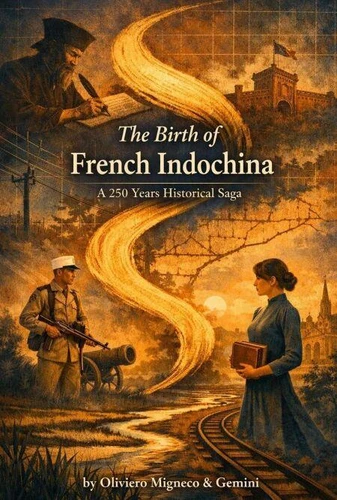
This book focuses on the Alphabet. You will see how a phonetic script (Qu?c Ng?), originally designed by European priests to "ghost" the native tongue, was seized by the Vietnamese people and turned into a weapon for liberation. It is a fascinating look at how the master's tools can be used to dismantle the master's house.2. A 250-Year Generational EpicThe story follows a single family lineage across three distinct eras of struggle:· The Scribe (1780s): The bridge-builder caught between faith and soil.· The Soldier (1860s): The guardian of the "Star Fortresses" who watches his world turn from stone to iron.· The Daughter (1910s): The "Gilded Exile" who learns the master's language to speak the truth of her own people.3.
The Geometry of ResistanceThe book uses the recurring metaphor of the "S-shape"-the natural, curved flow of the Vietnamese land-against the "Grid"-the straight, cold lines of French railroads, telegraphs, and taxes. You will learn how the Vietnamese people used the "Geometry of the Reeds" to outlast a civilization built on the "Geometry of the Machine."4. Emotional AuthenticityThis is a story of "Divided Souls." It captures the heartbreak of the collaborator, the futility of the martyr, and the quiet courage of the teacher.
It doesn't shy away from the brutality of the "Tax of Salt and Light" or the opium dens, but it finds beauty in the resilient grass of the Mekong.5. A New Perspective on DecolonizationBefore the world knew the names of the mid-century revolutions, the foundation was being laid in secret salons and highland schools. This book serves as the "Pre-History" of modern Vietnam, showing that independence was not a gift given at a treaty table, but a language that a nation had to learn to speak for itself.
By the end of this book, you won't just understand how French Indochina was born; you will understand why it could never truly exist as a permanent home for the Vietnamese spirit.
Why Should I Read This Book?You should read The Birth of French Indochina because it is not just a history of a territory, but a biography of a soul. It explores how a culture survives the most intimate form of conquest: the rewriting of its language and the literal redrawing of its landscape. Here is why this narrative is essential:1. The War of the WordsMost history books focus on the clash of swords and cannons.
This book focuses on the Alphabet. You will see how a phonetic script (Qu?c Ng?), originally designed by European priests to "ghost" the native tongue, was seized by the Vietnamese people and turned into a weapon for liberation. It is a fascinating look at how the master's tools can be used to dismantle the master's house.2. A 250-Year Generational EpicThe story follows a single family lineage across three distinct eras of struggle:· The Scribe (1780s): The bridge-builder caught between faith and soil.· The Soldier (1860s): The guardian of the "Star Fortresses" who watches his world turn from stone to iron.· The Daughter (1910s): The "Gilded Exile" who learns the master's language to speak the truth of her own people.3.
The Geometry of ResistanceThe book uses the recurring metaphor of the "S-shape"-the natural, curved flow of the Vietnamese land-against the "Grid"-the straight, cold lines of French railroads, telegraphs, and taxes. You will learn how the Vietnamese people used the "Geometry of the Reeds" to outlast a civilization built on the "Geometry of the Machine."4. Emotional AuthenticityThis is a story of "Divided Souls." It captures the heartbreak of the collaborator, the futility of the martyr, and the quiet courage of the teacher.
It doesn't shy away from the brutality of the "Tax of Salt and Light" or the opium dens, but it finds beauty in the resilient grass of the Mekong.5. A New Perspective on DecolonizationBefore the world knew the names of the mid-century revolutions, the foundation was being laid in secret salons and highland schools. This book serves as the "Pre-History" of modern Vietnam, showing that independence was not a gift given at a treaty table, but a language that a nation had to learn to speak for itself.
By the end of this book, you won't just understand how French Indochina was born; you will understand why it could never truly exist as a permanent home for the Vietnamese spirit.