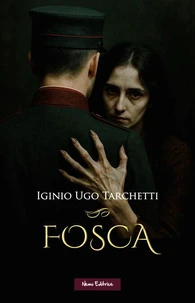
A nineteenth-century Italian novel that later inspired both a film and a Broadway musical - now in a vivid new English rendering. Giorgio is a young army officer recovering from a wound to the heart when he falls in love with two women who could not be less alike. Clara is beautiful, warm, and content - a love with no shadows, nothing to forgive. Then he meets Fosca: the colonel's cousin, wasted by illness, seized by violent nervous fits, and by her own account almost too ugly to look at.
She becomes the one woman he cannot walk away from. What follows is not a conventional love story. It is, in the narrator's own words, "the diagnosis of an illness" - an obsession Giorgio can neither justify, resist, nor fully survive. Iginio Ugo Tarchetti wrote Fosca in the last months of his life, racing an illness of his own; he died before finishing it, and a friend completed the final pages so the book could be published at all.
Forgotten for a century, the novel was rescued in 1971 when Italo Calvino chose it to launch a celebrated series of Italian classics - and found new audiences again through Ettore Scola's film Passione d'amore and, later, a Broadway musical based on it. A landmark of the Scapigliatura, Milan's rebellious nineteenth-century literary avant-garde, Fosca remains one of Italian literature's most unsettling meditations on beauty, illness, and desire.
This edition includes a historical-critical introduction on Tarchetti, the Scapigliatura movement, and the novel's afterlife on page, stage, and screen.
A nineteenth-century Italian novel that later inspired both a film and a Broadway musical - now in a vivid new English rendering. Giorgio is a young army officer recovering from a wound to the heart when he falls in love with two women who could not be less alike. Clara is beautiful, warm, and content - a love with no shadows, nothing to forgive. Then he meets Fosca: the colonel's cousin, wasted by illness, seized by violent nervous fits, and by her own account almost too ugly to look at.
She becomes the one woman he cannot walk away from. What follows is not a conventional love story. It is, in the narrator's own words, "the diagnosis of an illness" - an obsession Giorgio can neither justify, resist, nor fully survive. Iginio Ugo Tarchetti wrote Fosca in the last months of his life, racing an illness of his own; he died before finishing it, and a friend completed the final pages so the book could be published at all.
Forgotten for a century, the novel was rescued in 1971 when Italo Calvino chose it to launch a celebrated series of Italian classics - and found new audiences again through Ettore Scola's film Passione d'amore and, later, a Broadway musical based on it. A landmark of the Scapigliatura, Milan's rebellious nineteenth-century literary avant-garde, Fosca remains one of Italian literature's most unsettling meditations on beauty, illness, and desire.
This edition includes a historical-critical introduction on Tarchetti, the Scapigliatura movement, and the novel's afterlife on page, stage, and screen.

 , qui est-ce ?