Nouveauté
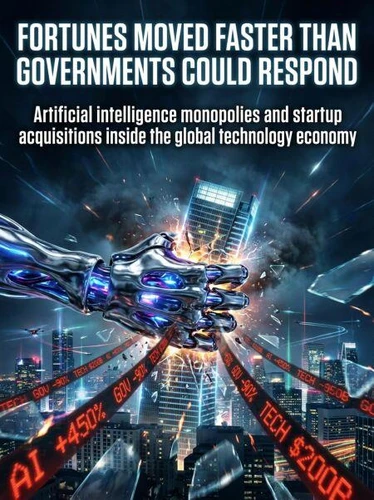
Fortunes Moved Faster Than Governments Could Respond. Artificial intelligence monopolies and startup acquisitions inside the global technology economy
Par :Formats :
Disponible dans votre compte client Decitre ou Furet du Nord dès validation de votre commande. Le format ePub est :
- Compatible avec une lecture sur My Vivlio (smartphone, tablette, ordinateur)
- Compatible avec une lecture sur liseuses Vivlio
- Pour les liseuses autres que Vivlio, vous devez utiliser le logiciel Adobe Digital Edition. Non compatible avec la lecture sur les liseuses Kindle, Remarkable et Sony
 , qui est-ce ?
Notre partenaire de plateforme de lecture numérique où vous retrouverez l'ensemble de vos ebooks gratuitement
Pour en savoir plus sur nos ebooks, consultez notre aide en ligne ici
C'est si simple ! Lisez votre ebook avec l'app Vivlio sur votre tablette, mobile ou ordinateur :

- Nombre de pages207
- FormatePub
- ISBN978-3-565-47914-6
- EAN9783565479146
- Date de parution05/06/2026
- Protection num.pas de protection
- Taille1 Mo
- Infos supplémentairesepub
- ÉditeurEmphaloz Publishing House
Résumé
The race for artificial intelligence quickly became a race for control itself. Venture capital flooded into machine learning companies, major platforms absorbed emerging competitors, and a handful of firms accumulated unprecedented influence over data, infrastructure, and technical talent. Innovation increasingly concentrated power instead of dispersing it.
This book investigates the rise of a new digital monopoly system surrounding companies such as OpenAI and other global technology giants.
Aggressive startup acquisitions, exclusive investment partnerships, and talent wars transformed the AI sector into a battlefield shaped as much by financial consolidation as by scientific research. Engineers became strategic assets, while independent firms struggled to survive against platforms capable of controlling cloud infrastructure and computational scale. The narrative also examines how governments repeatedly failed to regulate the expanding influence of the AI industry.
Lobbying networks inside the United States and European Union weakened attempts to address mass data extraction, copyright disputes, and market concentration. Legal frameworks designed for earlier internet economies struggled to confront corporations operating at planetary scale. The result is a portrait of artificial intelligence not only as technological progress, but as the latest stage in the global struggle over who controls knowledge, labor, and digital power.
Aggressive startup acquisitions, exclusive investment partnerships, and talent wars transformed the AI sector into a battlefield shaped as much by financial consolidation as by scientific research. Engineers became strategic assets, while independent firms struggled to survive against platforms capable of controlling cloud infrastructure and computational scale. The narrative also examines how governments repeatedly failed to regulate the expanding influence of the AI industry.
Lobbying networks inside the United States and European Union weakened attempts to address mass data extraction, copyright disputes, and market concentration. Legal frameworks designed for earlier internet economies struggled to confront corporations operating at planetary scale. The result is a portrait of artificial intelligence not only as technological progress, but as the latest stage in the global struggle over who controls knowledge, labor, and digital power.