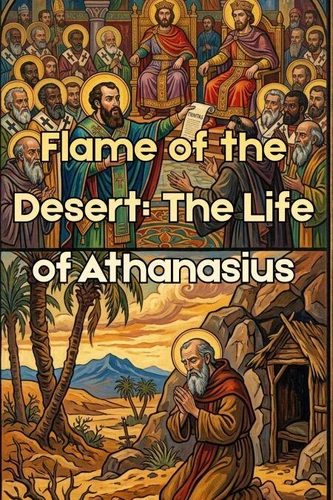
Flame of the Desert: The Life of Athanasius is a literary novel inspired by the life of Athanasius of Alexandria (c. 296-373 AD), one of the most tenacious figures in the history of Christianity. Written in the spiritual and symbolic style of Paulo Coelho, the novel traces the arc of a man born in the cosmopolitan crossroads of ancient Alexandria - a city where Greek philosophy, Egyptian mysticism, Jewish tradition, and early Christianity collided daily - and follows him through a lifetime of struggle, exile, and unshakeable conviction.
At the heart of the story lies the great Arian controversy: the fourth-century theological battle over the nature of Jesus Christ. When the priest Arius began teaching that the Son of God was a created being - lesser than the Father - Athanasius recognised in that seemingly subtle claim a threat to the very foundation of human salvation. He devoted his entire life to defending the Nicene Creed's declaration that the Son is of the same essence as the Father: homoousios.
What makes Athanasius extraordinary is not simply that he was right, but that he remained standing when almost everyone else sat down. Exiled five times by four different emperors, hunted through the Egyptian desert, abandoned even by the Pope - he never surrendered. History gave his resolve a name that has echoed through the centuries: Athanasius contra mundum - Athanasius against the world. This novel is ultimately not about theology.
It is about what it means to believe in something larger than yourself, and to keep walking even when the road disappears beneath your feet.
Flame of the Desert: The Life of Athanasius is a literary novel inspired by the life of Athanasius of Alexandria (c. 296-373 AD), one of the most tenacious figures in the history of Christianity. Written in the spiritual and symbolic style of Paulo Coelho, the novel traces the arc of a man born in the cosmopolitan crossroads of ancient Alexandria - a city where Greek philosophy, Egyptian mysticism, Jewish tradition, and early Christianity collided daily - and follows him through a lifetime of struggle, exile, and unshakeable conviction.
At the heart of the story lies the great Arian controversy: the fourth-century theological battle over the nature of Jesus Christ. When the priest Arius began teaching that the Son of God was a created being - lesser than the Father - Athanasius recognised in that seemingly subtle claim a threat to the very foundation of human salvation. He devoted his entire life to defending the Nicene Creed's declaration that the Son is of the same essence as the Father: homoousios.
What makes Athanasius extraordinary is not simply that he was right, but that he remained standing when almost everyone else sat down. Exiled five times by four different emperors, hunted through the Egyptian desert, abandoned even by the Pope - he never surrendered. History gave his resolve a name that has echoed through the centuries: Athanasius contra mundum - Athanasius against the world. This novel is ultimately not about theology.
It is about what it means to believe in something larger than yourself, and to keep walking even when the road disappears beneath your feet.

 , qui est-ce ?