An archivist who uncovered trade secrets from dusty records, weaving self-help on adaptive thinking, business lessons from ancient commerce, and detailed histories of global trade evolutions.
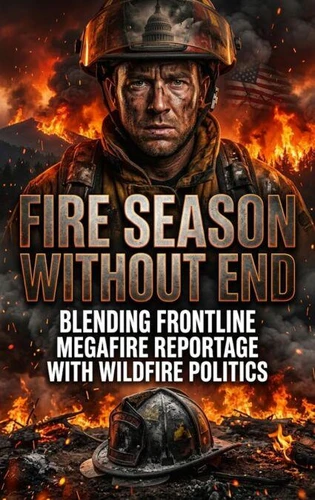
Fire Season without End. Blending Frontline Megafire Reportage with Wildfire Politics
Par :Formats :
Disponible dans votre compte client Decitre ou Furet du Nord dès validation de votre commande. Le format ePub est :
- Compatible avec une lecture sur My Vivlio (smartphone, tablette, ordinateur)
- Compatible avec une lecture sur liseuses Vivlio
- Pour les liseuses autres que Vivlio, vous devez utiliser le logiciel Adobe Digital Edition. Non compatible avec la lecture sur les liseuses Kindle, Remarkable et Sony
 , qui est-ce ?
Notre partenaire de plateforme de lecture numérique où vous retrouverez l'ensemble de vos ebooks gratuitement
Pour en savoir plus sur nos ebooks, consultez notre aide en ligne ici
C'est si simple ! Lisez votre ebook avec l'app Vivlio sur votre tablette, mobile ou ordinateur :

- Nombre de pages205
- FormatePub
- ISBN978-3-565-41112-2
- EAN9783565411122
- Date de parution14/04/2026
- Protection num.pas de protection
- Taille2 Mo
- Infos supplémentairesepub
- ÉditeurEmphaloz Publishing House
Résumé
A megafire is defined as a wildfire burning more than 100, 000 acres - a threshold that, as recently as the 1980s, was crossed only rarely and under exceptional conditions. Since 2000, more than a dozen American states have each broken their own historical record for the largest wildfire ever recorded, several of them breaking that record multiple times in the same decade. Colorado shattered its all-time record four times in four years beginning in 2010.
The 2013 Rim Fire in California's Sierra Nevada was, at the time of burning, the second largest wildfire in the state's recorded history - and by 2023 it ranked merely eleventh. The era of the megafire is not a warning of what may come. It is an accounting of what has already arrived. The science behind this transformation is not in dispute. Three converging forces have restructured fire's relationship with the American landscape: a century of aggressive fire suppression - codified in the US Forest Service's 1935 "10 a.m.
policy, " which mandated the extinguishing of every fire by the morning after detection - created a vast accumulation of unburned biomass in Western forests that now functions as fuel waiting for ignition. Climate change has extended fire seasons, reduced snowpack, and produced the sustained drought conditions in which vegetation desiccates into tinder months earlier than historical norms permitted.
And decades of residential development into the wildland-urban interface - the contested, poorly governed boundary where human settlement meets combustible forest - has placed hundreds of thousands of homes in the direct path of fires that no suppression strategy was ever designed to stop.
The 2013 Rim Fire in California's Sierra Nevada was, at the time of burning, the second largest wildfire in the state's recorded history - and by 2023 it ranked merely eleventh. The era of the megafire is not a warning of what may come. It is an accounting of what has already arrived. The science behind this transformation is not in dispute. Three converging forces have restructured fire's relationship with the American landscape: a century of aggressive fire suppression - codified in the US Forest Service's 1935 "10 a.m.
policy, " which mandated the extinguishing of every fire by the morning after detection - created a vast accumulation of unburned biomass in Western forests that now functions as fuel waiting for ignition. Climate change has extended fire seasons, reduced snowpack, and produced the sustained drought conditions in which vegetation desiccates into tinder months earlier than historical norms permitted.
And decades of residential development into the wildland-urban interface - the contested, poorly governed boundary where human settlement meets combustible forest - has placed hundreds of thousands of homes in the direct path of fires that no suppression strategy was ever designed to stop.
A propos de Dahlia Ives






9,99 €