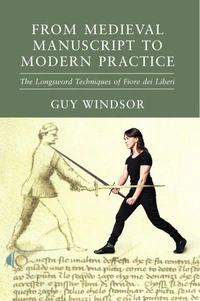
*This instalment of The Swordsman's Quick Guide has been included as a chapter in the author's book The Theory and Practice of Historical Martial Arts.* Fencing theory is the intellectual, abstract structure that fencers use to describe, define, and explain their art. In this book, professional swordsmanship instructor and author Guy Windsor introduces you to the uses of fencing theory, and explains in detail all the major concepts.
You can then use this theory to better analyse and understand whatever swordsmanship style you practice. The main areas covered here are: Doctrine: the idea behind the art. What is the best way to win a sword fight? What is the best kind of sword fight? Strategy: the end-state that you aim for in a fight. Stab him in the face; disarm him; throw him to the ground, score 5 points before he does. Tactics: the choice of specific techniques that will lead to your strategic goal.
Time: the timing of your actions relative to those of your opponent. Many styles define actions in terms of the number of motions they require, and distinguish between acting before, during or after your opponent's motion. Measure: the distance between the two fencers. Any fencing action has a specific measure in which it works best, and most styles distinguish between being able to hit without stepping, or with a single footwork action, or requiring more than one step.
Many also include grappling measure. Postures: the static positions that are defined in the art; even in arts where there is no standing still, there is usually at least one "on guard" position defined somewhere. Actions: movements of the sword or body. Cuts, thrusts, parries, lunges, passing steps, turns, steps, even backflips. Combinations: specific actions strung together in sequence, usually for tactical reasons.
Common combinations often get given names and are thought of as "a technique", such as the punta falsa, the krumphau, the scannatura, the one-two. Mechanics: very few historical fencing sources discuss mechanics in any detail, but most give at least some indication of how an action should be done. Additional elements: many sources or styles also include other elements, such as virtues and philosophy.
*This instalment of The Swordsman's Quick Guide has been included as a chapter in the author's book The Theory and Practice of Historical Martial Arts.* Fencing theory is the intellectual, abstract structure that fencers use to describe, define, and explain their art. In this book, professional swordsmanship instructor and author Guy Windsor introduces you to the uses of fencing theory, and explains in detail all the major concepts.
You can then use this theory to better analyse and understand whatever swordsmanship style you practice. The main areas covered here are: Doctrine: the idea behind the art. What is the best way to win a sword fight? What is the best kind of sword fight? Strategy: the end-state that you aim for in a fight. Stab him in the face; disarm him; throw him to the ground, score 5 points before he does. Tactics: the choice of specific techniques that will lead to your strategic goal.
Time: the timing of your actions relative to those of your opponent. Many styles define actions in terms of the number of motions they require, and distinguish between acting before, during or after your opponent's motion. Measure: the distance between the two fencers. Any fencing action has a specific measure in which it works best, and most styles distinguish between being able to hit without stepping, or with a single footwork action, or requiring more than one step.
Many also include grappling measure. Postures: the static positions that are defined in the art; even in arts where there is no standing still, there is usually at least one "on guard" position defined somewhere. Actions: movements of the sword or body. Cuts, thrusts, parries, lunges, passing steps, turns, steps, even backflips. Combinations: specific actions strung together in sequence, usually for tactical reasons.
Common combinations often get given names and are thought of as "a technique", such as the punta falsa, the krumphau, the scannatura, the one-two. Mechanics: very few historical fencing sources discuss mechanics in any detail, but most give at least some indication of how an action should be done. Additional elements: many sources or styles also include other elements, such as virtues and philosophy.