A policy wonk immersed in financial upheavals, authoring self-help decision aids, business risk management guides, and histories of banking reforms from crises to stability.
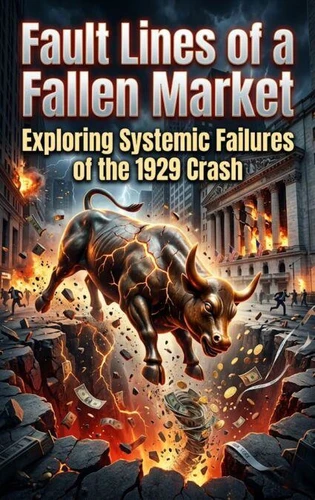
Fault Lines of a Fallen Market. Exploring Systemic Failures of the 1929 Crash
Par :Formats :
Disponible dans votre compte client Decitre ou Furet du Nord dès validation de votre commande. Le format ePub est :
- Compatible avec une lecture sur My Vivlio (smartphone, tablette, ordinateur)
- Compatible avec une lecture sur liseuses Vivlio
- Pour les liseuses autres que Vivlio, vous devez utiliser le logiciel Adobe Digital Edition. Non compatible avec la lecture sur les liseuses Kindle, Remarkable et Sony
 , qui est-ce ?
Notre partenaire de plateforme de lecture numérique où vous retrouverez l'ensemble de vos ebooks gratuitement
Pour en savoir plus sur nos ebooks, consultez notre aide en ligne ici
C'est si simple ! Lisez votre ebook avec l'app Vivlio sur votre tablette, mobile ou ordinateur :

- Nombre de pages156
- FormatePub
- ISBN978-3-565-40371-4
- EAN9783565403714
- Date de parution11/04/2026
- Protection num.pas de protection
- Taille2 Mo
- Infos supplémentairesepub
- ÉditeurEmphaloz Publishing House
Résumé
The Wall Street Crash of 1929 was not a single catastrophic event - it was the visible rupture of a financial system riddled with structural fault lines that had been accumulating for years. By the time the Dow Jones Industrial Average fell nearly 13% on Black Monday, October 28, 1929, the conditions for collapse had long been in place: speculative excess, dangerously thin margin requirements of just 10%, fragile banking architecture, and a Federal Reserve that would prove fatally hesitant in its response.
This book examines the 1929 crash not as a historical footnote but as a masterclass in systemic failure - the kind of cascading breakdown that occurs when financial interdependence is mistaken for financial strength.
It traces the chain reactions that transformed a stock market correction into a decade-long global depression: the wave of bank failures triggered by margin calls that could not be repaid, the pyramid-like correspondent banking network that amplified risk across the entire system, raising systemic risk by 33% as roughly 9, 000 banks failed, and the Federal Reserve's catastrophic decision to allow the money supply to contract by nearly 30% between 1930 and 1933.
It examines the structural weaknesses identified by economist John Kenneth Galbraith - bad banking structure, foreign trade imbalances, rampant speculation, poor income distribution, and the fragility of holding companies - and how each interacted with the others to accelerate the downward spiral.
It traces the chain reactions that transformed a stock market correction into a decade-long global depression: the wave of bank failures triggered by margin calls that could not be repaid, the pyramid-like correspondent banking network that amplified risk across the entire system, raising systemic risk by 33% as roughly 9, 000 banks failed, and the Federal Reserve's catastrophic decision to allow the money supply to contract by nearly 30% between 1930 and 1933.
It examines the structural weaknesses identified by economist John Kenneth Galbraith - bad banking structure, foreign trade imbalances, rampant speculation, poor income distribution, and the fragility of holding companies - and how each interacted with the others to accelerate the downward spiral.
A propos de Kian Tate









24,99 €