
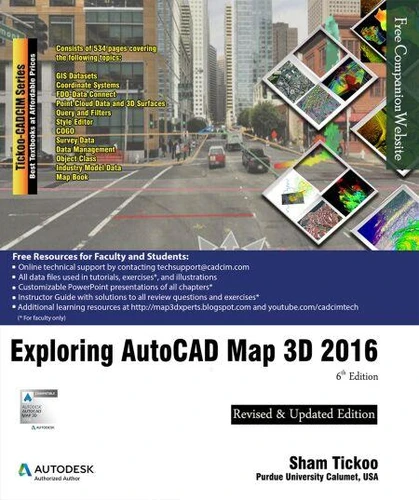
Exploring AutoCAD Map 3D 2016
Par :Formats :
Disponible dans votre compte client Decitre ou Furet du Nord dès validation de votre commande. Le format ePub protégé est :
- Compatible avec une lecture sur My Vivlio (smartphone, tablette, ordinateur)
- Compatible avec une lecture sur liseuses Vivlio
- Pour les liseuses autres que Vivlio, vous devez utiliser le logiciel Adobe Digital Edition. Non compatible avec la lecture sur les liseuses Kindle, Remarkable et Sony
- Non compatible avec un achat hors France métropolitaine
 , qui est-ce ?
Notre partenaire de plateforme de lecture numérique où vous retrouverez l'ensemble de vos ebooks gratuitement
Pour en savoir plus sur nos ebooks, consultez notre aide en ligne ici
C'est si simple ! Lisez votre ebook avec l'app Vivlio sur votre tablette, mobile ou ordinateur :

- FormatePub
- ISBN978-1-386-14237-9
- EAN9781386142379
- Date de parution10/08/2017
- Protection num.Adobe DRM
- Infos supplémentairesepub
- ÉditeurRelay Publishing
Résumé
Exploring AutoCAD Map 3D 2016 is a comprehensive textbook that has been written to cater to the needs of the students and the professionals. The chapters in this textbook are structured in a pedagogical sequence, which makes the learning process very simple and effective for both the novice as well as the advanced users of AutoCAD Map 3D. In this textbook, complex geospatial processes have been illustrated through easy-to-understand flow diagrams.
Also, various processes such as creating feature and drawing objects, managing object data, and displaying spatial data have been covered in this textbook. This edition also introduces users to the concepts of industry model database for managing spatial data. The simple and lucid language used in this textbook makes it a ready reference for both the beginners and the intermediate users. The salient features of the textbook are as follows: .
Tutorial ApproachThe author has adopted the tutorial point-of-view and learn-by-doing approach throughout the textbook. This approach guides the users through various processes involved in creating and analyzing spatial data. At the end of each chapter, tutorials are provided to practice the concepts learned in the chapter. . Real-World Projects as TutorialsThe author has used about 30 real-world GIS projects as tutorials in this book.
This will enable the readers to relate the tutorials to the real-world projects in GIS industry. In addition, there are about 20 exercises based on the real-world GIS projects. . Tips and NotesThe additional information related to various topics is provided to the users in the form of tips and notes. . Learning ObjectivesThe first page of every chapter summarizes the topics that are covered in that chapter. .
Self-Evaluation Test, Review Questions, and ExercisesThe chapters end with Self-Evaluation Test so that the users can assess their knowledge of the chapter. The answers to Self-Evaluation Test are given at the end of the chapter. Also, the Review Questions and Exercises are given at the end of each chapter and they can be used by Instructors as test questions and exercises. . Heavily Illustrated TextThe text in this book is heavily illustrated with about 300 line diagrams and screen capture images.
Also, various processes such as creating feature and drawing objects, managing object data, and displaying spatial data have been covered in this textbook. This edition also introduces users to the concepts of industry model database for managing spatial data. The simple and lucid language used in this textbook makes it a ready reference for both the beginners and the intermediate users. The salient features of the textbook are as follows: .
Tutorial ApproachThe author has adopted the tutorial point-of-view and learn-by-doing approach throughout the textbook. This approach guides the users through various processes involved in creating and analyzing spatial data. At the end of each chapter, tutorials are provided to practice the concepts learned in the chapter. . Real-World Projects as TutorialsThe author has used about 30 real-world GIS projects as tutorials in this book.
This will enable the readers to relate the tutorials to the real-world projects in GIS industry. In addition, there are about 20 exercises based on the real-world GIS projects. . Tips and NotesThe additional information related to various topics is provided to the users in the form of tips and notes. . Learning ObjectivesThe first page of every chapter summarizes the topics that are covered in that chapter. .
Self-Evaluation Test, Review Questions, and ExercisesThe chapters end with Self-Evaluation Test so that the users can assess their knowledge of the chapter. The answers to Self-Evaluation Test are given at the end of the chapter. Also, the Review Questions and Exercises are given at the end of each chapter and they can be used by Instructors as test questions and exercises. . Heavily Illustrated TextThe text in this book is heavily illustrated with about 300 line diagrams and screen capture images.
A propos de Sham Tickoo


33,49 €
33,49 €

33,49 €
33,49 €

33,49 €

35,49 €

36,99 €


36,99 €


