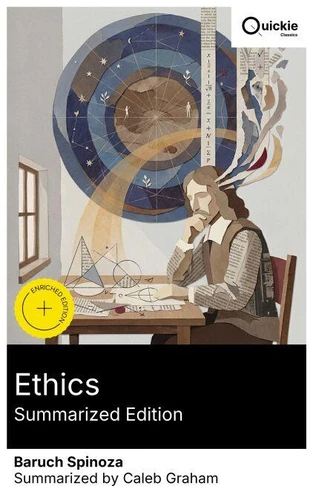
Ethics (Summarized Edition). Enriched edition. A Rationalist exploration of metaphysics, human nature, and moral principles through the geometric method of 17th-century Spinozism
Par : , ,Formats :
Disponible dans votre compte client Decitre ou Furet du Nord dès validation de votre commande. Le format ePub est :
- Compatible avec une lecture sur My Vivlio (smartphone, tablette, ordinateur)
- Compatible avec une lecture sur liseuses Vivlio
- Pour les liseuses autres que Vivlio, vous devez utiliser le logiciel Adobe Digital Edition. Non compatible avec la lecture sur les liseuses Kindle, Remarkable et Sony
 , qui est-ce ?
Notre partenaire de plateforme de lecture numérique où vous retrouverez l'ensemble de vos ebooks gratuitement
Pour en savoir plus sur nos ebooks, consultez notre aide en ligne ici
C'est si simple ! Lisez votre ebook avec l'app Vivlio sur votre tablette, mobile ou ordinateur :

- Nombre de pages123
- FormatePub
- ISBN859-65--4788064-6
- EAN8596547880646
- Date de parution10/01/2026
- Protection num.Digital Watermarking
- Taille728 Ko
- Infos supplémentairesepub
- ÉditeurLivio Editions
Résumé
Ethics unfolds in the austere geometrical method-definitions, axioms, propositions, scholia-deriving a monistic metaphysics where God or Nature (Deus sive Natura) is the one substance, of which thought and extension are known attributes. From this basis Spinoza deduces mind-body parallelism, strict determinism, and a naturalistic psychology of the affects, mapping a path from bondage to freedom that culminates in the intellectual love of God.
Composed amid seventeenth-century rationalism and in dialogue with Descartes and scholasticism, the work fuses metaphysics, epistemology, and ethics into a single science of flourishing. Born to Portuguese-Jewish refugees in Amsterdam, Spinoza (1632-1677) was excommunicated in 1656, a rupture that enabled an independent life supported by lens-grinding within the relatively free Dutch Republic. His correspondence and early writings show a critical engagement with Cartesian method and biblical hermeneutics; the Ethics, completed late and published posthumously in 1677, distills these projects into a system intended as therapy of the passions as much as demonstration.
For readers seeking an architectonic vision of nature and a lucid guide to resilient living, the Ethics is indispensable. It rewards patient study across metaphysics, moral psychology, and theology, illuminating contemporary debates on freedom, emotion, and mind-body relations with austere, hard-won clarity. Quickie Classics summarizes timeless works with precision, preserving the author's voice and keeping the prose clear, fast, and readable-distilled, never diluted.
Enriched Edition extras: Introduction · Synopsis · Historical Context · Author Biography · Brief Analysis · 4 Reflection Q&As · Editorial Footnotes.
Composed amid seventeenth-century rationalism and in dialogue with Descartes and scholasticism, the work fuses metaphysics, epistemology, and ethics into a single science of flourishing. Born to Portuguese-Jewish refugees in Amsterdam, Spinoza (1632-1677) was excommunicated in 1656, a rupture that enabled an independent life supported by lens-grinding within the relatively free Dutch Republic. His correspondence and early writings show a critical engagement with Cartesian method and biblical hermeneutics; the Ethics, completed late and published posthumously in 1677, distills these projects into a system intended as therapy of the passions as much as demonstration.
For readers seeking an architectonic vision of nature and a lucid guide to resilient living, the Ethics is indispensable. It rewards patient study across metaphysics, moral psychology, and theology, illuminating contemporary debates on freedom, emotion, and mind-body relations with austere, hard-won clarity. Quickie Classics summarizes timeless works with precision, preserving the author's voice and keeping the prose clear, fast, and readable-distilled, never diluted.
Enriched Edition extras: Introduction · Synopsis · Historical Context · Author Biography · Brief Analysis · 4 Reflection Q&As · Editorial Footnotes.