SOLDES
Jusqu'à -70% sur une sélection d'articles*

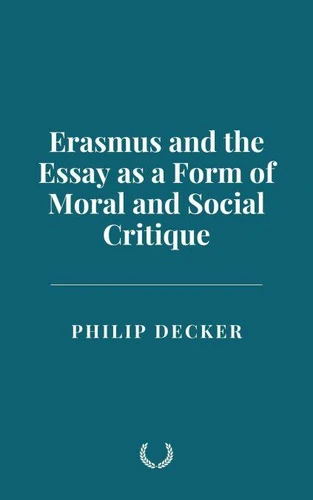
Erasmus and the Essay as a Form of Moral and Social Critique
Par :Formats :
Disponible dans votre compte client Decitre ou Furet du Nord dès validation de votre commande. Le format ePub est :
- Compatible avec une lecture sur My Vivlio (smartphone, tablette, ordinateur)
- Compatible avec une lecture sur liseuses Vivlio
- Pour les liseuses autres que Vivlio, vous devez utiliser le logiciel Adobe Digital Edition. Non compatible avec la lecture sur les liseuses Kindle, Remarkable et Sony
 , qui est-ce ?
Notre partenaire de plateforme de lecture numérique où vous retrouverez l'ensemble de vos ebooks gratuitement
Pour en savoir plus sur nos ebooks, consultez notre aide en ligne ici
C'est si simple ! Lisez votre ebook avec l'app Vivlio sur votre tablette, mobile ou ordinateur :

- FormatePub
- ISBN8231105335
- EAN9798231105335
- Date de parution22/06/2025
- Protection num.pas de protection
- Infos supplémentairesepub
- ÉditeurWalzone Press
Résumé
Erasmus and the Essay as a Form of Moral and Social Critique offers a groundbreaking exploration of how one of the Renaissance's greatest humanists transformed the humble essay into a powerful tool for ethical reflection and social change. Through a vivid analysis of Desiderius Erasmus's masterworks-The Praise of Folly, Colloquies, and more-this book reveals how Erasmus combined razor-sharp satire, classical rhetoric, and Christian humanism to expose the follies of his age: clerical corruption, intellectual vanity, and societal hypocrisy.
Set against the dramatic backdrop of early sixteenth-century Europe, a time of religious upheaval and the dawn of print culture, this volume uncovers how Erasmus's essays helped popularize a new mode of public discourse-one that engaged scholars and lay readers alike in a conversation about virtue, reason, and reform. It traces Erasmus's profound influence on contemporaries and successors, from Thomas More to Montaigne, and shows how his rhetorical innovations paved the way for the modern essay and the Enlightenment's emphasis on critical thinking.
Blending rigorous scholarship with accessible prose, this book illuminates Erasmus's enduring relevance as a thinker who challenged power with wit, bridled intellectual arrogance with humility, and championed dialogue over division. For readers fascinated by Renaissance history, literature, theology, and the evolution of ideas, this work offers a compelling narrative of how a single author's essays helped shape the course of Western thought and the art of moral critique itself.
Set against the dramatic backdrop of early sixteenth-century Europe, a time of religious upheaval and the dawn of print culture, this volume uncovers how Erasmus's essays helped popularize a new mode of public discourse-one that engaged scholars and lay readers alike in a conversation about virtue, reason, and reform. It traces Erasmus's profound influence on contemporaries and successors, from Thomas More to Montaigne, and shows how his rhetorical innovations paved the way for the modern essay and the Enlightenment's emphasis on critical thinking.
Blending rigorous scholarship with accessible prose, this book illuminates Erasmus's enduring relevance as a thinker who challenged power with wit, bridled intellectual arrogance with humility, and championed dialogue over division. For readers fascinated by Renaissance history, literature, theology, and the evolution of ideas, this work offers a compelling narrative of how a single author's essays helped shape the course of Western thought and the art of moral critique itself.
A propos de Philip Decker
2,99 €
2,99 €
2,99 €


2,99 €

2,99 €


2,99 €