The "Epistle of Barnabas" stands as a profound early Christian text that intricately weaves doctrinal teachings with a distinctive epistolary style. Written in the late first or early second century, it explores themes of faith, eschatology, and the interpretation of the Jewish laws from a Christian perspective. The author employs a rigorous allegorical method, often drawing from the Hebrew Scriptures to elucidate the nascent Christian faith, thus situating the text within the complex theological context of early Christianity's formative years.
Its rich rhetorical strategies and ethical exhortations reflect both a response to the challenges of its time and a deep engagement with contemporary socio-religious dynamics, making it a critical study for understanding the intersection of Judaism and early Christianity. The authorship of the "Epistle of Barnabas" remains ambiguous, yet this anonymity speaks to its universal appeal among early Christian communities grappling with identity and doctrine.
Likely originating from an Alexandrian milieu, the text illustrates the author's intention to consolidate Christian beliefs amidst a predominantly Jewish framework, arguably influenced by the community's struggle to define itself in the wake of the Apostolic era. Readers searching for insight into the early Christian theological landscape will find the "Epistle of Barnabas" invaluable. Its depth of thought and rich allegorical elements are essential for scholars of early Christianity, while its themes remain strikingly relevant for modern discussions of faith and interpretation.
Engage with this seminal work to enrich your understanding of the complex tapestry that is early Christian thought.
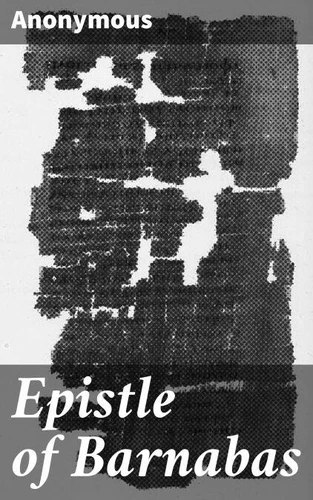
The "Epistle of Barnabas" stands as a profound early Christian text that intricately weaves doctrinal teachings with a distinctive epistolary style. Written in the late first or early second century, it explores themes of faith, eschatology, and the interpretation of the Jewish laws from a Christian perspective. The author employs a rigorous allegorical method, often drawing from the Hebrew Scriptures to elucidate the nascent Christian faith, thus situating the text within the complex theological context of early Christianity's formative years.
Its rich rhetorical strategies and ethical exhortations reflect both a response to the challenges of its time and a deep engagement with contemporary socio-religious dynamics, making it a critical study for understanding the intersection of Judaism and early Christianity. The authorship of the "Epistle of Barnabas" remains ambiguous, yet this anonymity speaks to its universal appeal among early Christian communities grappling with identity and doctrine.
Likely originating from an Alexandrian milieu, the text illustrates the author's intention to consolidate Christian beliefs amidst a predominantly Jewish framework, arguably influenced by the community's struggle to define itself in the wake of the Apostolic era. Readers searching for insight into the early Christian theological landscape will find the "Epistle of Barnabas" invaluable. Its depth of thought and rich allegorical elements are essential for scholars of early Christianity, while its themes remain strikingly relevant for modern discussions of faith and interpretation.
Engage with this seminal work to enrich your understanding of the complex tapestry that is early Christian thought.


 , qui est-ce ?