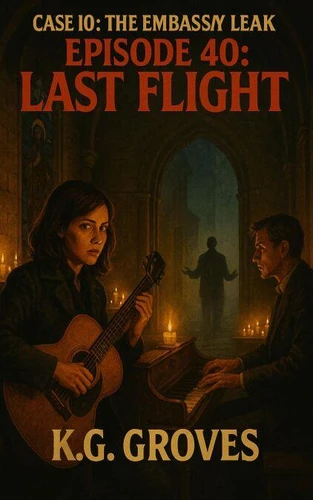
Hiding in a working-class church that runs on harmoniums and lemon oil, Jack and Kira borrow a priest's back room, burner phone, and stubborn faith to turn the embassy leak into something the city can't quietly bury. While a choir sings loud enough to cover calls to the umbrella woman and the paper, they bargain for ten minutes of "quiet" over the shrimp canal, then race there to steal a ledger and two older kids from a storage room that was never meant for people.
With fog, keys, and a stringer in a fake hat, they ghost the children out through a basin that pretends not to notice, leaving the book behind but pocketing the strip of bell codes that made the whole pipeline run. The street closes around them-market rain, boys with sockets and cigarettes, a dog bought off with a raised hand-until the priest smuggles them onto a bread bus under a sack of onions and a nun's calm report that the kids are eating crackers and keeping their names for now.
Hunted by a bounty car and saved by a driver who loves salsa more than fear, they ride out of the city into a neighborhood of unregistered ovens and unforgivable politics, where a baker's phone and coffee let them confirm the rescue, bury the codes, and remind Ruth the filter is still shot. By the time the fruit sellers' spoon-bell rings six, the ledger is compromised, the kids are alive, and the house's net has more holes than it knows.
Jack and Kira walk into a quieter night as Kira counts her past sins in faces and Jack answers in math: today, at least, they bought time.
Hiding in a working-class church that runs on harmoniums and lemon oil, Jack and Kira borrow a priest's back room, burner phone, and stubborn faith to turn the embassy leak into something the city can't quietly bury. While a choir sings loud enough to cover calls to the umbrella woman and the paper, they bargain for ten minutes of "quiet" over the shrimp canal, then race there to steal a ledger and two older kids from a storage room that was never meant for people.
With fog, keys, and a stringer in a fake hat, they ghost the children out through a basin that pretends not to notice, leaving the book behind but pocketing the strip of bell codes that made the whole pipeline run. The street closes around them-market rain, boys with sockets and cigarettes, a dog bought off with a raised hand-until the priest smuggles them onto a bread bus under a sack of onions and a nun's calm report that the kids are eating crackers and keeping their names for now.
Hunted by a bounty car and saved by a driver who loves salsa more than fear, they ride out of the city into a neighborhood of unregistered ovens and unforgivable politics, where a baker's phone and coffee let them confirm the rescue, bury the codes, and remind Ruth the filter is still shot. By the time the fruit sellers' spoon-bell rings six, the ledger is compromised, the kids are alive, and the house's net has more holes than it knows.
Jack and Kira walk into a quieter night as Kira counts her past sins in faces and Jack answers in math: today, at least, they bought time.

 , qui est-ce ?