
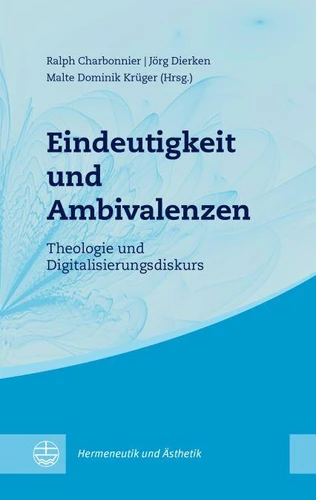
Eindeutigkeit und Ambivalenzen. Theologie und Digitalisierungsdiskurs
Par : , ,Formats :
Disponible dans votre compte client Decitre ou Furet du Nord dès validation de votre commande. Le format PDF est :
- Compatible avec une lecture sur My Vivlio (smartphone, tablette, ordinateur)
- Compatible avec une lecture sur liseuses Vivlio
- Pour les liseuses autres que Vivlio, vous devez utiliser le logiciel Adobe Digital Edition. Non compatible avec la lecture sur les liseuses Kindle, Remarkable et Sony
 , qui est-ce ?
Notre partenaire de plateforme de lecture numérique où vous retrouverez l'ensemble de vos ebooks gratuitement
Pour en savoir plus sur nos ebooks, consultez notre aide en ligne ici
C'est si simple ! Lisez votre ebook avec l'app Vivlio sur votre tablette, mobile ou ordinateur :

- Nombre de pages348
- FormatPDF
- ISBN978-3-374-06967-5
- EAN9783374069675
- Date de parution01/09/2021
- Protection num.Digital Watermarking
- Taille8 Mo
- Infos supplémentairespdf
- ÉditeurEvangelische Verlagsanstalt
Résumé
Digitale Medien prägen die Kommunikationskultur. Ihr binärer Code verstärkt ein Denken in "ja - nein", "entweder - oder", "like - dislike". Dies trifft auf lebensweltliche Erfahrungen von Mehrdeutigkeit. Löst digitale Kommunikation diese Ambiguität auf? Oder kann sie hilfreich zu ihrer Wahrnehmung beitragen - und wenn ja, wie? Diese Fragen betreffen durch Verarbeitungs-Algorithmen weite Bereiche menschlichen Lebens.
Protestantische Theologie ruht selbst auf dualen Unterscheidungen von Un-/Heil, Leben/Tod, Gott/Mensch. Zugleich ist für sie die Logik des "sowohl - als auch" konstitutiv: Gott ist verborgen und offenbar, der Mensch Sünder und Gerechter. Der Band entfaltet protestantische Perspektiven im öffentlichen Digitalisierungsdiskurs: Wie kann eine menschengerechte, ambiguitätssensible Kommunikation in Zeiten der Digitalisierung aussehen? Und wie verändern Digitalisierungsprozesse ihrerseits religiöse Kommunikation? Mit Beiträgen von Christiane Axt-Piscalar, Ralph Charbonnier, Jörg Dierken, Martin Jockel, Michael Klessmann, Joachim Knape, Dietrich Korsch, Constantin Plaul, Jürgen Rink [Unambiguity and Ambivalences.
Theology and the Discourse on Digitalization] Digital media shape the culture of communication. Their binary code reinforces a thinking in "yes - no", "either - or", "like - dislike". This encounters life-world experiences of ambiguity. Does digital communication resolve this ambiguity? Or can it helpfully contribute to its perception - and if so, how? These questions affect through processing algorithms wide areas of human life.
Protestant theology itself is based on dual distinctions of non-/salvation, life/death, God/human being. At the same time, the logic of "as well as" is constitutive for it: God is hidden and revealed, the human person sinner and righteous.
Protestantische Theologie ruht selbst auf dualen Unterscheidungen von Un-/Heil, Leben/Tod, Gott/Mensch. Zugleich ist für sie die Logik des "sowohl - als auch" konstitutiv: Gott ist verborgen und offenbar, der Mensch Sünder und Gerechter. Der Band entfaltet protestantische Perspektiven im öffentlichen Digitalisierungsdiskurs: Wie kann eine menschengerechte, ambiguitätssensible Kommunikation in Zeiten der Digitalisierung aussehen? Und wie verändern Digitalisierungsprozesse ihrerseits religiöse Kommunikation? Mit Beiträgen von Christiane Axt-Piscalar, Ralph Charbonnier, Jörg Dierken, Martin Jockel, Michael Klessmann, Joachim Knape, Dietrich Korsch, Constantin Plaul, Jürgen Rink [Unambiguity and Ambivalences.
Theology and the Discourse on Digitalization] Digital media shape the culture of communication. Their binary code reinforces a thinking in "yes - no", "either - or", "like - dislike". This encounters life-world experiences of ambiguity. Does digital communication resolve this ambiguity? Or can it helpfully contribute to its perception - and if so, how? These questions affect through processing algorithms wide areas of human life.
Protestant theology itself is based on dual distinctions of non-/salvation, life/death, God/human being. At the same time, the logic of "as well as" is constitutive for it: God is hidden and revealed, the human person sinner and righteous.