
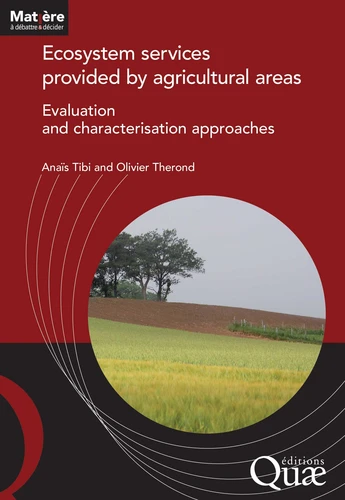
Ecosystem services provided by agricultural areas. Evaluation and characterisation approaches
Par : ,Formats :
Disponible dans votre compte client Decitre ou Furet du Nord dès validation de votre commande. Le format Multi-format est :
- Pour les liseuses autres que Vivlio, vous devez utiliser le logiciel Adobe Digital Edition. Non compatible avec la lecture sur les liseuses Kindle, Remarkable et Sony
 , qui est-ce ?
Notre partenaire de plateforme de lecture numérique où vous retrouverez l'ensemble de vos ebooks gratuitement
Pour en savoir plus sur nos ebooks, consultez notre aide en ligne ici
C'est si simple ! Lisez votre ebook avec l'app Vivlio sur votre tablette, mobile ou ordinateur :

- Nombre de pages172
- FormatMulti-format
- ISBN978-2-7592-4015-9
- EAN9782759240159
- Date de parution06/12/2024
- Protection num.NC
- Infos supplémentairesMulti-format incluant PDF sans p...
- ÉditeurQuae
- PréfacierGuy Richard
- PréfacierFrançoise Lescourret
Résumé
Ecosystem services (ES) can be defined as the components of ecosystems from which humans derive benefits, such as crop pollination and climate regulation. In a bid to ensure that biodiversity is taken into account in public and private decision-making, the French Ministry in charge of the Environment has commissioned INRAE (former Inra) to assess the ES provided by agricultural ecosystems. This book summarises the main results of this work, carried out between 2014 and 2017 by a multidisciplinary group of experts.
Fourteen ES are described and assessed using an ad hoc conceptual framework that takes account of the specific features of these anthropised areas. Among the original advances, the estimation of the current contribution of ES to agricultural production and the representation of interactions between ES provide the knowledge needed to design production systems that consume fewer artificial inputs (synthetic fertilisers, pesticides) and respond to societal challenges such as conserving biodiversity and limiting environmental impacts.
Finally, this book underlines the caution with which economic evaluation should be used. This book is aimed at researchers and students working on the interactions between biodiversity and ecosystem functioning. It will also be of interest to all those involved in land management: farmers, local authorities, environmental associations, etc.
Fourteen ES are described and assessed using an ad hoc conceptual framework that takes account of the specific features of these anthropised areas. Among the original advances, the estimation of the current contribution of ES to agricultural production and the representation of interactions between ES provide the knowledge needed to design production systems that consume fewer artificial inputs (synthetic fertilisers, pesticides) and respond to societal challenges such as conserving biodiversity and limiting environmental impacts.
Finally, this book underlines the caution with which economic evaluation should be used. This book is aimed at researchers and students working on the interactions between biodiversity and ecosystem functioning. It will also be of interest to all those involved in land management: farmers, local authorities, environmental associations, etc.
A propos de Anaïs Tibi
Protéger les cultures par la diversité végétale
Grand Format
29,00 €
34,00 €
