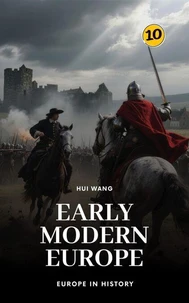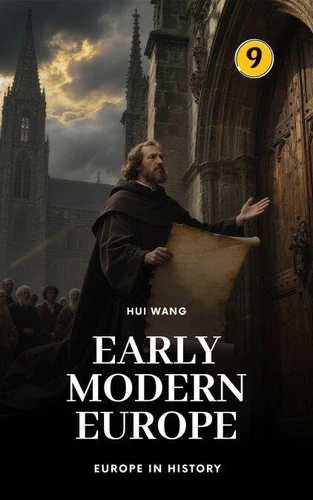
Early Modern Europe: Europe in History. Europe in History, #9
Par :Formats :
Disponible dans votre compte client Decitre ou Furet du Nord dès validation de votre commande. Le format ePub est :
- Compatible avec une lecture sur My Vivlio (smartphone, tablette, ordinateur)
- Compatible avec une lecture sur liseuses Vivlio
- Pour les liseuses autres que Vivlio, vous devez utiliser le logiciel Adobe Digital Edition. Non compatible avec la lecture sur les liseuses Kindle, Remarkable et Sony
 , qui est-ce ?
Notre partenaire de plateforme de lecture numérique où vous retrouverez l'ensemble de vos ebooks gratuitement
Pour en savoir plus sur nos ebooks, consultez notre aide en ligne ici
C'est si simple ! Lisez votre ebook avec l'app Vivlio sur votre tablette, mobile ou ordinateur :

- FormatePub
- ISBN978-91-90150-28-3
- EAN9789190150283
- Date de parution21/02/2026
- Protection num.pas de protection
- Infos supplémentairesepub
- ÉditeurHui Wang
Résumé
Early Modern Europe: Europe in History, PART ONE, throws open a door to a continent where old kingdoms begin to crack and new powers push through the fissures. I lead you into the age of Mehmed II (whose 1453 CE capture of Constantinople reshaped the eastern Mediterranean), and into the courts of Isabella of Castile and Ferdinand of Aragon-the Catholic Monarchs-whose decisions remade Spain and sent ripples across the wider Mediterranean.
From the last embers of the medieval order to Charles VIII's bold venture into Italy, these opening chapters trail rulers, popes, and armies as they stride and stumble toward a turning point that will redefine Europe. As the story unfolds, reformist voices begin to echo and then roar across the continent. Martin Luther's Ninety-Five Theses (1517 CE) set off fierce debates about faith and salvation, opening a struggle over justification by faith that leaves Charles V ruling a fracturing imperial realm.
The Defenestration of Prague and the campaigns of Christian IV and Gustavus Adolphus soon pull the narrative into the great conflagration of the Thirty Years' War (1618-1648 CE) - a collision of religion and power that will alter the future of the Holy Roman Empire. Italy turns into a theater of intrigue and creation. The tangled relationships between Pope Sixtus IV, the Medici family, and the multiple upheavals that toppled and restored Florence-from the Medici's exile in 1494 to the republic's final collapse in 1530-show how politics and art were braided together during the Renaissance.
You'll meet Leo X and the High Renaissance papacy, watch the rivalry between Francis I and Charles V spread like wildfire across Italian courts, and witness the dramatic Sack of Rome in 1527 CE-a shock that forced Europe to rethink the balance between spiritual authority and political survival. The rise of the Jesuits (formally approved in 1540 CE) and the wider Catholic revival add another, fierce layer to this shifting world.
France sits at the center of its own violent transformation. Catherine de' Medici struggles to hold a fractured kingdom together while her son Charles IX faces the horror of the Saint Bartholomew's Day Massacre in 1572 CE. The rise of the Huguenots, the fragile compromise of the Edict of Nantes in 1598 CE, and the tangled, pragmatic reign of Henry IV reveal how conflict and conciliation forged a new political order.
After Henry's assassination, Marie de' Medici's regency exposes the fragility of dynastic rule, and the ascent of Cardinal Richelieu shows how royal sovereignty slowly, inexorably tightened its grip over nobles and provinces.
From the last embers of the medieval order to Charles VIII's bold venture into Italy, these opening chapters trail rulers, popes, and armies as they stride and stumble toward a turning point that will redefine Europe. As the story unfolds, reformist voices begin to echo and then roar across the continent. Martin Luther's Ninety-Five Theses (1517 CE) set off fierce debates about faith and salvation, opening a struggle over justification by faith that leaves Charles V ruling a fracturing imperial realm.
The Defenestration of Prague and the campaigns of Christian IV and Gustavus Adolphus soon pull the narrative into the great conflagration of the Thirty Years' War (1618-1648 CE) - a collision of religion and power that will alter the future of the Holy Roman Empire. Italy turns into a theater of intrigue and creation. The tangled relationships between Pope Sixtus IV, the Medici family, and the multiple upheavals that toppled and restored Florence-from the Medici's exile in 1494 to the republic's final collapse in 1530-show how politics and art were braided together during the Renaissance.
You'll meet Leo X and the High Renaissance papacy, watch the rivalry between Francis I and Charles V spread like wildfire across Italian courts, and witness the dramatic Sack of Rome in 1527 CE-a shock that forced Europe to rethink the balance between spiritual authority and political survival. The rise of the Jesuits (formally approved in 1540 CE) and the wider Catholic revival add another, fierce layer to this shifting world.
France sits at the center of its own violent transformation. Catherine de' Medici struggles to hold a fractured kingdom together while her son Charles IX faces the horror of the Saint Bartholomew's Day Massacre in 1572 CE. The rise of the Huguenots, the fragile compromise of the Edict of Nantes in 1598 CE, and the tangled, pragmatic reign of Henry IV reveal how conflict and conciliation forged a new political order.
After Henry's assassination, Marie de' Medici's regency exposes the fragility of dynastic rule, and the ascent of Cardinal Richelieu shows how royal sovereignty slowly, inexorably tightened its grip over nobles and provinces.