Eleven people entered Frightning Farm Land. None came back. Their evidence did. Lieutenant Miller arrives at the abandoned Pennsylvania attraction expecting a mass-fatality investigation. Eleven bodies. Damaged structures. A wounded masked killer still somewhere near the property. Blood, footprints, tool marks, recordings, medical telemetry, maps, photographs, and thousands of surviving files should be enough to reconstruct what happened.
Some of it is. The masked man is human. He bleeds. He kills. He repairs broken doors, clears drainage channels, straightens failing hardware, and returns to the property even when escape would be easier. His crimes belong to him. But not everything does. A recovery truck suddenly carries thousands of pounds of additional support reaction with no identified source. An old iron reference moves without the ground behaving as though it moved.
A door is recorded open and closed during what may be the same interval. Physical evidence supports both conditions. Then a bridge forty miles away begins carrying weight that is not there. The investigation can no longer remain inside Frightning Farm Land. As engineers, police investigators, evidence specialists, physicists, and government officials build independent systems to preserve what they observe, one instruction left behind by the dead becomes increasingly important:VERIFY INDEPENDENTLY.
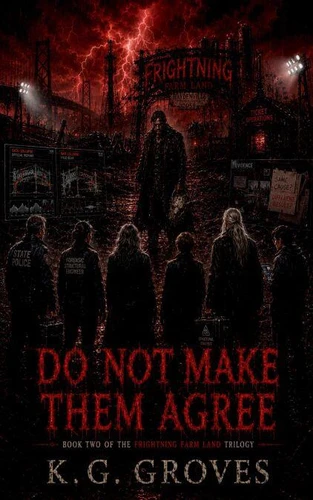
KEEP ORIGINALS. DO NOT MAKE THEM AGREE. Because the greatest danger may not be uncertainty. It may be a system becoming too good at resolving it. Do Not Make Them Agree is Book Two of the Frightning Farm Land Trilogy, an evidence-driven speculative horror thriller about murder, impossible measurements, institutional pressure, scientific restraint, and the terrifying consequences of forcing reality into one answer before the evidence has earned it.
The human violence remains human. The unexplained remains unexplained. And this time, the farm is no longer the only place being measured.
Eleven people entered Frightning Farm Land. None came back. Their evidence did. Lieutenant Miller arrives at the abandoned Pennsylvania attraction expecting a mass-fatality investigation. Eleven bodies. Damaged structures. A wounded masked killer still somewhere near the property. Blood, footprints, tool marks, recordings, medical telemetry, maps, photographs, and thousands of surviving files should be enough to reconstruct what happened.
Some of it is. The masked man is human. He bleeds. He kills. He repairs broken doors, clears drainage channels, straightens failing hardware, and returns to the property even when escape would be easier. His crimes belong to him. But not everything does. A recovery truck suddenly carries thousands of pounds of additional support reaction with no identified source. An old iron reference moves without the ground behaving as though it moved.
A door is recorded open and closed during what may be the same interval. Physical evidence supports both conditions. Then a bridge forty miles away begins carrying weight that is not there. The investigation can no longer remain inside Frightning Farm Land. As engineers, police investigators, evidence specialists, physicists, and government officials build independent systems to preserve what they observe, one instruction left behind by the dead becomes increasingly important:VERIFY INDEPENDENTLY.
KEEP ORIGINALS. DO NOT MAKE THEM AGREE. Because the greatest danger may not be uncertainty. It may be a system becoming too good at resolving it. Do Not Make Them Agree is Book Two of the Frightning Farm Land Trilogy, an evidence-driven speculative horror thriller about murder, impossible measurements, institutional pressure, scientific restraint, and the terrifying consequences of forcing reality into one answer before the evidence has earned it.
The human violence remains human. The unexplained remains unexplained. And this time, the farm is no longer the only place being measured.