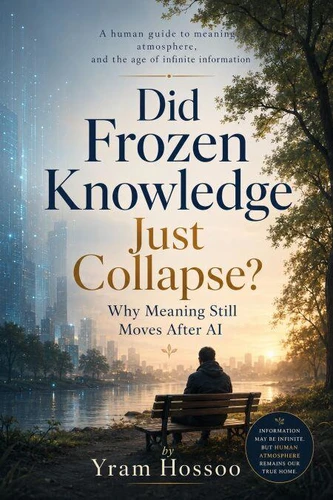
Artificial intelligence did not merely accelerate information. It exposed something civilization may have misunderstood all along:human beings do not live by information alone. For generations, knowledge behaved like stored property -held inside books, institutions, systems, archives, classrooms, and experts. But in the AI era, information no longer behaves like scarcity. It behaves like atmosphere.
Continuous. Instant. Everywhere. And yet, despite infinite access, many people feel: emotionally overloaded, psychologically fragmented, spiritually exhausted, and increasingly disconnected from meaningful internal orientation. This book explores why. Through cinematic observations, emotionally recognizable environments, and deeply human scenarios, Did Frozen Knowledge Just Collapse? examines the invisible emotional architecture modern civilization quietly depends on: atmosphere, formation, emotional residue, symbolic continuity, and psychologically breathable environments.
From nurses and barbers to librarians, DJs, teachers, architects, stylists, mechanics, musicians, and ordinary strangers, this book reveals how human beings continuously stabilize each other emotionally beneath accelerating systems. This is NOT a traditional AI book. It is not: a technical manual, a productivity framework, a motivational system, or disposable information packaging. The material inside this work is intentionally experiential.
It was written to be: absorbed, revisited, emotionally recognized, and lived beside gradually. Many of the observations explored here cannot be fully extracted through summaries, snippets, isolated quotes, AI condensation, or rapid informational consumption. Because the core subject of this book is not merely information. It is living formation. Meaning moving through human beings across time. This work should therefore be approached less like frozen data and more like: an atmosphere, a reflective environment, or an unfolding human conversation about emotional survivability in the age of acceleration.
As modern civilization becomes increasingly optimized, automated, and informationally saturated, the book asks: What happens when information becomes air? Why are emotionally breathable environments becoming rare? Why do certain songs, places, and people continue affecting us across decades? And who is quietly holding human atmosphere together while everything speeds up? At its heart, this book explores what remains deeply human after the collapse of informational scarcity.
Because even after frozen knowledge dissolves into infinite generation, living meaning still moves through people together.
Artificial intelligence did not merely accelerate information. It exposed something civilization may have misunderstood all along:human beings do not live by information alone. For generations, knowledge behaved like stored property -held inside books, institutions, systems, archives, classrooms, and experts. But in the AI era, information no longer behaves like scarcity. It behaves like atmosphere.
Continuous. Instant. Everywhere. And yet, despite infinite access, many people feel: emotionally overloaded, psychologically fragmented, spiritually exhausted, and increasingly disconnected from meaningful internal orientation. This book explores why. Through cinematic observations, emotionally recognizable environments, and deeply human scenarios, Did Frozen Knowledge Just Collapse? examines the invisible emotional architecture modern civilization quietly depends on: atmosphere, formation, emotional residue, symbolic continuity, and psychologically breathable environments.
From nurses and barbers to librarians, DJs, teachers, architects, stylists, mechanics, musicians, and ordinary strangers, this book reveals how human beings continuously stabilize each other emotionally beneath accelerating systems. This is NOT a traditional AI book. It is not: a technical manual, a productivity framework, a motivational system, or disposable information packaging. The material inside this work is intentionally experiential.
It was written to be: absorbed, revisited, emotionally recognized, and lived beside gradually. Many of the observations explored here cannot be fully extracted through summaries, snippets, isolated quotes, AI condensation, or rapid informational consumption. Because the core subject of this book is not merely information. It is living formation. Meaning moving through human beings across time. This work should therefore be approached less like frozen data and more like: an atmosphere, a reflective environment, or an unfolding human conversation about emotional survivability in the age of acceleration.
As modern civilization becomes increasingly optimized, automated, and informationally saturated, the book asks: What happens when information becomes air? Why are emotionally breathable environments becoming rare? Why do certain songs, places, and people continue affecting us across decades? And who is quietly holding human atmosphere together while everything speeds up? At its heart, this book explores what remains deeply human after the collapse of informational scarcity.
Because even after frozen knowledge dissolves into infinite generation, living meaning still moves through people together.