Nach dem Studium der Physik war Dr. Carl Freytag bis 1996 am Meteorologischen Institut der Universität München tätig. 1976 promovierte er über atmosphärische Turbulenz und habilitierte sich 1988 mit einer Arbeit über den Wind im Inntal. Jenseits der Wetterkarte arbeitet er im Bereich Kulturgeschichte/Philosophie und Zeitgeschichte und arbeitet als freier Publizist und Übersetzer.
Oliver Rathkolb war von 2006 bis 2024 Professor am Institut für Zeitgeschichte der Universität Wien, Vorsitzender des internationalen wissenschaftlichen Beirats des Hauses der Europäischen Geschichte in Brüssel und Vorstandsmitglied des Jüdischen Museums Wien und des Salzburger Festspielarchivs.
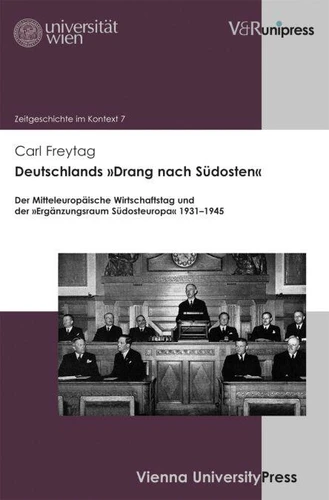
Deutschlands »Drang nach Südosten«. Der Mitteleuropäische Wirtschaftstag und der »Ergänzungsraum Südosteuropa« 1931–1945
Par : ,Formats :
Disponible dans votre compte client Decitre ou Furet du Nord dès validation de votre commande. Le format PDF est :
- Compatible avec une lecture sur My Vivlio (smartphone, tablette, ordinateur)
- Compatible avec une lecture sur liseuses Vivlio
- Pour les liseuses autres que Vivlio, vous devez utiliser le logiciel Adobe Digital Edition. Non compatible avec la lecture sur les liseuses Kindle, Remarkable et Sony
 , qui est-ce ?
Notre partenaire de plateforme de lecture numérique où vous retrouverez l'ensemble de vos ebooks gratuitement
Pour en savoir plus sur nos ebooks, consultez notre aide en ligne ici
C'est si simple ! Lisez votre ebook avec l'app Vivlio sur votre tablette, mobile ou ordinateur :

- Nombre de pages467
- FormatPDF
- ISBN978-3-86234-992-0
- EAN9783862349920
- Date de parution11/09/2012
- Protection num.pas de protection
- Taille5 Mo
- Infos supplémentairespdf
- ÉditeurV&R Unipress
Résumé
In 1931, the heavy industry at Rhine and Ruhr took over the Berlin-based German section of the "Mitteleuropäischer Wirtschaftstag" (MWT). The president of the association, Tilo von Wilmowsky, was a protagonist of engineered and economically organized agriculture. He was also the brother-in-law of Gustav Krupp, giving him the ability to bring about a marriage between "manor and furnace" and to discover - later with the help of IG-Farben director Max Ilgner and Ulrich von Hassell - a way out of the German crisis of export and agriculture.
With distance to the racist policies of the NS-regime and partly in opposition to its foreign trade policies, 1931-1945 the MWT took part in the construction of a "Großwirtschaftsraum", led by Germany. The MWT tried to retain the position of the "free entrepreneurship" in the context of "ordered capitalism", and, at the same time, improved as a developing company the living conditions in the "Ergänzungsraum" South-East Europe by sustainable farming projects in order to create a suitable market for the goods of the MWT-members.
With distance to the racist policies of the NS-regime and partly in opposition to its foreign trade policies, 1931-1945 the MWT took part in the construction of a "Großwirtschaftsraum", led by Germany. The MWT tried to retain the position of the "free entrepreneurship" in the context of "ordered capitalism", and, at the same time, improved as a developing company the living conditions in the "Ergänzungsraum" South-East Europe by sustainable farming projects in order to create a suitable market for the goods of the MWT-members.