An archivist who uncovered trade secrets from dusty records, weaving self-help on adaptive thinking, business lessons from ancient commerce, and detailed histories of global trade evolutions.
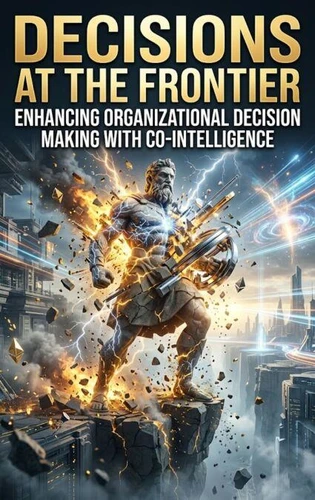
Decisions at the Frontier. Enhancing Organizational Decision Making with Co-Intelligence
Par :Formats :
Disponible dans votre compte client Decitre ou Furet du Nord dès validation de votre commande. Le format ePub est :
- Compatible avec une lecture sur My Vivlio (smartphone, tablette, ordinateur)
- Compatible avec une lecture sur liseuses Vivlio
- Pour les liseuses autres que Vivlio, vous devez utiliser le logiciel Adobe Digital Edition. Non compatible avec la lecture sur les liseuses Kindle, Remarkable et Sony
 , qui est-ce ?
Notre partenaire de plateforme de lecture numérique où vous retrouverez l'ensemble de vos ebooks gratuitement
Pour en savoir plus sur nos ebooks, consultez notre aide en ligne ici
C'est si simple ! Lisez votre ebook avec l'app Vivlio sur votre tablette, mobile ou ordinateur :

- Nombre de pages151
- FormatePub
- ISBN978-3-565-39969-7
- EAN9783565399697
- Date de parution10/04/2026
- Protection num.pas de protection
- Taille2 Mo
- Infos supplémentairesepub
- ÉditeurEmphaloz Publishing House
Résumé
By 2027, Gartner projects that 50% of all business decisions will be augmented or automated by AI agents - yet most organizations remain structurally unprepared to govern the human-AI decision-making partnership this shift demands. Co-intelligence, the framework articulated by Wharton's Ethan Mollick, reframes this challenge not as a question of AI adoption, but as a discipline of human-AI collaboration - one that requires organizations to develop new norms of trust, accountability, and complementary intelligence to function effectively.
The era of the solitary executive decision has not ended; it has expanded into something far more structurally complex and potentially far more powerful. This book examines how organizations can build co-intelligence architectures - the systems, roles, and behavioral frameworks that enable humans and AI to make better decisions together than either could make independently. Drawing on Mollick's four rules of co-intelligence, Tom Davenport's classification of structured, semi-structured, and unstructured AI-assisted decisions, and the Brookings Institution's research on collective AI-augmented intelligence, it maps the specific conditions under which human judgment and AI analytical depth combine to generate superior strategic, operational, and adaptive decision outcomes.
Being the human in the loop is not a passive role - it is the most strategically critical position in any AI-enhanced decision system.
The era of the solitary executive decision has not ended; it has expanded into something far more structurally complex and potentially far more powerful. This book examines how organizations can build co-intelligence architectures - the systems, roles, and behavioral frameworks that enable humans and AI to make better decisions together than either could make independently. Drawing on Mollick's four rules of co-intelligence, Tom Davenport's classification of structured, semi-structured, and unstructured AI-assisted decisions, and the Brookings Institution's research on collective AI-augmented intelligence, it maps the specific conditions under which human judgment and AI analytical depth combine to generate superior strategic, operational, and adaptive decision outcomes.
Being the human in the loop is not a passive role - it is the most strategically critical position in any AI-enhanced decision system.
A propos de Dahlia Ives



9,99 €