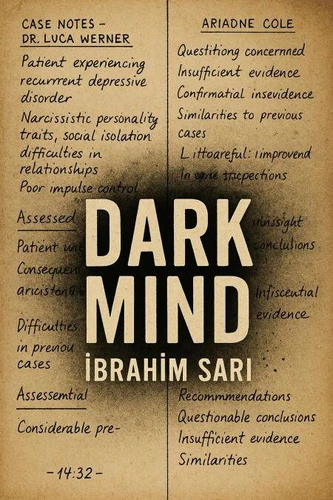
Dark Mind is a psychological and procedural thriller built on fractures-of time, of evidence, and of the rooms that teach people how to move. Presented in a dual-column format, the novel pairs Dr. Luca Werner's clinical logs with Ariadne Cole's incisive counter-commentary, allowing the reader to navigate a crime from two angles at once. What emerges is less a confession and more an audit of how a city shapes behavior.
The story begins with the so-called mirror murders-cases staged to resemble self-inflicted endings, each arranged with eerie precision. When handwriting found in a victim's final page matches Luca's clinical notes, suspicion turns inward. But Ariadne notices a quieter anomaly: Luca's timestamps drift by exactly seventeen seconds, always toward now. Instead of searching for a villain, she examines the architecture, the timing, and the interfaces that seem to push people across decisions.
The novel treats rooms, screens, sounds, and even fonts as potential suspects. It interrogates procedures, pre-chimes, countdown impulses, and the subtle coercions that shape human action. Lamps angled at thirty degrees, minutes-only boards, witness strips, and "Air Units" of rest become tools-not just for the investigators, but for the reader navigating each scene. Dark Mind explores psychological manipulation, interface-driven coercion, and the ethics of timing with meticulous detail.
It is a thriller where dread doesn't chase-it counts. Where evidence hides in tempo. Where two investigators must learn to read not only the clues, but the behaviors created by the spaces around them. A novel for readers who enjoy layered narratives, intellectual tension, and atmospheres where every second-and every pause-matters. Count seven. Count fourteen. Read across.
Dark Mind is a psychological and procedural thriller built on fractures-of time, of evidence, and of the rooms that teach people how to move. Presented in a dual-column format, the novel pairs Dr. Luca Werner's clinical logs with Ariadne Cole's incisive counter-commentary, allowing the reader to navigate a crime from two angles at once. What emerges is less a confession and more an audit of how a city shapes behavior.
The story begins with the so-called mirror murders-cases staged to resemble self-inflicted endings, each arranged with eerie precision. When handwriting found in a victim's final page matches Luca's clinical notes, suspicion turns inward. But Ariadne notices a quieter anomaly: Luca's timestamps drift by exactly seventeen seconds, always toward now. Instead of searching for a villain, she examines the architecture, the timing, and the interfaces that seem to push people across decisions.
The novel treats rooms, screens, sounds, and even fonts as potential suspects. It interrogates procedures, pre-chimes, countdown impulses, and the subtle coercions that shape human action. Lamps angled at thirty degrees, minutes-only boards, witness strips, and "Air Units" of rest become tools-not just for the investigators, but for the reader navigating each scene. Dark Mind explores psychological manipulation, interface-driven coercion, and the ethics of timing with meticulous detail.
It is a thriller where dread doesn't chase-it counts. Where evidence hides in tempo. Where two investigators must learn to read not only the clues, but the behaviors created by the spaces around them. A novel for readers who enjoy layered narratives, intellectual tension, and atmospheres where every second-and every pause-matters. Count seven. Count fourteen. Read across.


 , qui est-ce ?