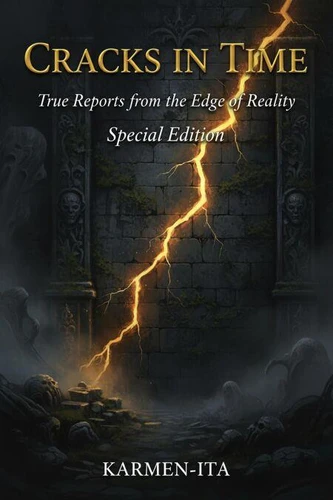
What if the dead are not gone - but recorded?For centuries, witnesses have reported the same phenomenon: figures in period clothing, performing repetitive tasks, unaware of being observed. At West Point in 1972. On a commercial flight in 1973. On a school playing field in Zimbabwe in 1994, witnessed by sixty-two children simultaneously. Cracks in Time investigates these accounts not through the lens of belief, but through the lens of science.
Drawing on M-theory, piezoelectric physics, electromagnetic research, and the neuroscience of anomalous experience, this book proposes a framework in which certain locations - ancient stone buildings, industrial ruins, geological fault zones - may function as recording devices, storing and replaying fragments of human activity across time. This is not a ghost story. It is a scientific investigation into why so many people, across so many centuries, keep seeing the same thing.
What if the dead are not gone - but recorded?For centuries, witnesses have reported the same phenomenon: figures in period clothing, performing repetitive tasks, unaware of being observed. At West Point in 1972. On a commercial flight in 1973. On a school playing field in Zimbabwe in 1994, witnessed by sixty-two children simultaneously. Cracks in Time investigates these accounts not through the lens of belief, but through the lens of science.
Drawing on M-theory, piezoelectric physics, electromagnetic research, and the neuroscience of anomalous experience, this book proposes a framework in which certain locations - ancient stone buildings, industrial ruins, geological fault zones - may function as recording devices, storing and replaying fragments of human activity across time. This is not a ghost story. It is a scientific investigation into why so many people, across so many centuries, keep seeing the same thing.


 , qui est-ce ?