Author
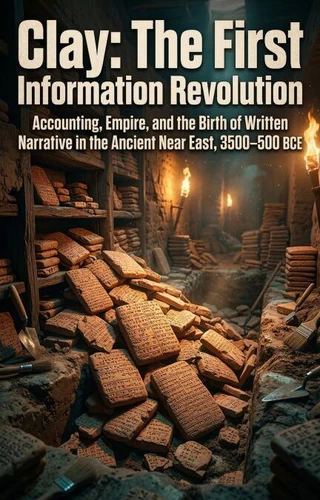
Clay: The First Information Revolution. Accounting, Empire, and the Birth of Written Narrative in the Ancient Near East, 3500–500 BCE
Par :Formats :
Disponible dans votre compte client Decitre ou Furet du Nord dès validation de votre commande. Le format ePub est :
- Compatible avec une lecture sur My Vivlio (smartphone, tablette, ordinateur)
- Compatible avec une lecture sur liseuses Vivlio
- Pour les liseuses autres que Vivlio, vous devez utiliser le logiciel Adobe Digital Edition. Non compatible avec la lecture sur les liseuses Kindle, Remarkable et Sony
 , qui est-ce ?
Notre partenaire de plateforme de lecture numérique où vous retrouverez l'ensemble de vos ebooks gratuitement
Pour en savoir plus sur nos ebooks, consultez notre aide en ligne ici
C'est si simple ! Lisez votre ebook avec l'app Vivlio sur votre tablette, mobile ou ordinateur :

- Nombre de pages218
- FormatePub
- ISBN978-3-565-33540-4
- EAN9783565335404
- Date de parution18/03/2026
- Protection num.pas de protection
- Taille785 Ko
- Infos supplémentairesepub
- ÉditeurEmphaloz Publishing House
Résumé
"Clay: The First Information Revolution" challenges the conventional narrative of the origin of writing, positioning the humble clay tablet as the catalyst for the world's first true information revolution. Far from starting with poetry or law, the first scripts were utilitarian tools for accounting-tracking barley rations and sheep hocks. This book uncovers the hidden mechanics of how a system of tokens transformed into complex cuneiform, enabling the administration of the first empires.
The reader will explore the forgotten archives of Mesopotamia, where scribes developed the first data management systems.
We discover how this need for precise record-keeping laid the groundwork for literature, from legal codes like Hammurabi's to the Epic of Gilgamesh. The text reveals the socio-political impact of literacy, the power dynamics of the scribal class, and the resilience of a medium that has outlasted all digital formats. "Clay" is a meticulous exploration of how a simple material shaped human thought and organization.
It offers academics and historians a fresh perspective on the materiality of communication, arguing that the true digital revolution began not with the silicon chip, but with the first stylus pressed into wet clay.
We discover how this need for precise record-keeping laid the groundwork for literature, from legal codes like Hammurabi's to the Epic of Gilgamesh. The text reveals the socio-political impact of literacy, the power dynamics of the scribal class, and the resilience of a medium that has outlasted all digital formats. "Clay" is a meticulous exploration of how a simple material shaped human thought and organization.
It offers academics and historians a fresh perspective on the materiality of communication, arguing that the true digital revolution began not with the silicon chip, but with the first stylus pressed into wet clay.
A propos de Alistair Finch

Shadow
E-book
0,99 €

Tides of Honest Hearts
E-book
0,99 €

2,99 €

The Virus
E-book
1,99 €




The Enterprise Protocol
E-book
1,99 €

The Contract of Us
E-book
0,99 €

The Solomom Cipher
E-book
1,99 €

Operation Icarus
E-book
1,99 €

1,99 €

Salt of the Earth
E-book
1,99 €

1,99 €

0,99 €