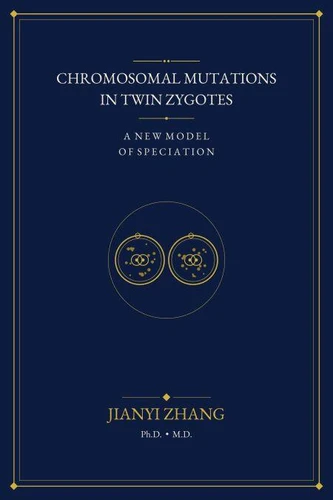
This book presents a new theory of speciation called the Twin Zygotes Model. For over a century, evolutionary biology has been guided by Neo-Darwinism - the view that new species emerge through the gradual accumulation of small genetic mutations, shaped by natural selection over vast stretches of time. While this framework has explained much, it has left a number of fundamental biological puzzles unresolved: the absence of transitional fossils, the explosive diversity of the Cambrian period, the origins of novel organs, and the precise mechanism by which one species becomes two.
The Twin Zygotes Model proposes a different mechanism. It holds that new species arise not through gradual change but through large-scale chromosomal mutations occurring simultaneously in twin fertilized eggs of opposite sexes within the same maternal body. These twin zygotes, carrying identical gross chromosomal changes, can mate with each other but no longer with the parent species. In a single generation, a reproductively isolated population is born.
The model's four constituent elements - twin zygotes of both sexes, matching chromosomal mutations, multiple births from mutant zygotes, and first-generation inbreeding - are all observable natural phenomena, consistent with known reproductive biology. This work examines the theoretical foundations of the model, surveys the biological evidence that supports it, and applies it to longstanding problems that mainstream theory has struggled to resolve.
Following Karl Popper's criterion of falsifiability, the author specifies explicit predictions that would, if contradicted by evidence, disprove the model. The book also explores the model's broader implications - for our understanding of the diversity of species, moral behavior, and the nature of scientific progress itself. It is written for readers with a serious interest in evolutionary biology who are willing to engage with a challenging alternative to receiving opinions.
This book presents a new theory of speciation called the Twin Zygotes Model. For over a century, evolutionary biology has been guided by Neo-Darwinism - the view that new species emerge through the gradual accumulation of small genetic mutations, shaped by natural selection over vast stretches of time. While this framework has explained much, it has left a number of fundamental biological puzzles unresolved: the absence of transitional fossils, the explosive diversity of the Cambrian period, the origins of novel organs, and the precise mechanism by which one species becomes two.
The Twin Zygotes Model proposes a different mechanism. It holds that new species arise not through gradual change but through large-scale chromosomal mutations occurring simultaneously in twin fertilized eggs of opposite sexes within the same maternal body. These twin zygotes, carrying identical gross chromosomal changes, can mate with each other but no longer with the parent species. In a single generation, a reproductively isolated population is born.
The model's four constituent elements - twin zygotes of both sexes, matching chromosomal mutations, multiple births from mutant zygotes, and first-generation inbreeding - are all observable natural phenomena, consistent with known reproductive biology. This work examines the theoretical foundations of the model, surveys the biological evidence that supports it, and applies it to longstanding problems that mainstream theory has struggled to resolve.
Following Karl Popper's criterion of falsifiability, the author specifies explicit predictions that would, if contradicted by evidence, disprove the model. The book also explores the model's broader implications - for our understanding of the diversity of species, moral behavior, and the nature of scientific progress itself. It is written for readers with a serious interest in evolutionary biology who are willing to engage with a challenging alternative to receiving opinions.

 , qui est-ce ?
