
An amateur biologist, and a physician in private practice
Nouveauté
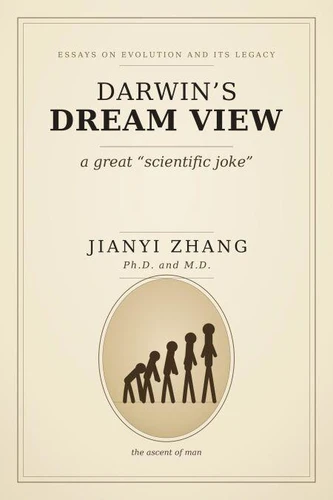
DARWIN’S Dream View: A Great “Scientific” Joke
Par :Formats :
Disponible dans votre compte client Decitre ou Furet du Nord dès validation de votre commande. Le format ePub est :
- Compatible avec une lecture sur My Vivlio (smartphone, tablette, ordinateur)
- Compatible avec une lecture sur liseuses Vivlio
- Pour les liseuses autres que Vivlio, vous devez utiliser le logiciel Adobe Digital Edition. Non compatible avec la lecture sur les liseuses Kindle, Remarkable et Sony
 , qui est-ce ?
Notre partenaire de plateforme de lecture numérique où vous retrouverez l'ensemble de vos ebooks gratuitement
Pour en savoir plus sur nos ebooks, consultez notre aide en ligne ici
C'est si simple ! Lisez votre ebook avec l'app Vivlio sur votre tablette, mobile ou ordinateur :

- FormatePub
- ISBN8235841468
- EAN9798235841468
- Date de parution04/07/2026
- Protection num.pas de protection
- Infos supplémentairesepub
- ÉditeurIoakim Ioakim
Résumé
Darwin's 1859 theory of evolution by natural selection has become foundational across biology, philosophy, and geopolitics. Yet this entrenchment demands scrutiny. While biological change is undeniable, Darwin's specific mechanism for speciation - sustained intraspecific competition for limited resources leading to reproductive isolation - remains unproven and unfalsifiable. Biological evolution encompasses three distinct layers: macro-evolution (common descent), micro-evolution (heritable variation within populations), and Darwin's core claim that micro-evolutionary struggle accumulates to forge new species.
The first two are empirically robust. The third lacks direct demonstration. No study has shown a population, under documented resource scarcity, diverging into reproductively isolated species over observable timescales. The Modern Synthesis integrated Mendelian genetics and random mutation into Darwin's framework, yet proponents never specify which original elements were discarded. The result is a "laundry-list" theory - perpetually updated without admitting what has been invalidated.
When challenged, the "core" shrinks to mere adaptation; when unchallenged, it expands to grand speciation claims. By Popper's criterion, this renders it pseudoscience: a theory immune to disproof cannot qualify as genuine science. Equally troubling is the silence around Darwin's central concept - the struggle for existence. Rooted in Malthusian competition, it became the scaffolding for Social Darwinism, eugenics, and racial ideologies underpinning Nazi Germany.
Mainstream evolutionists quietly retire this foundation without retracting it, maintaining an illusion of unbroken continuity. The critique is methodological, not anti-evolution. Variation, heredity, adaptation, and common descent are affirmed. What is rejected is the unverified Darwinian engine and the silence surrounding its historical consequences. Drawing on 57 focused essays, the author - holding both a Ph.
D. and an M. D.- brings the dual lens of scientific training and clinical reasoning to questions biologists have shielded from scrutiny. Each essay isolates a specific weakness: from the circularity of "survival of the fittest, " to the collapse of ring-species evidence under molecular analysis, to the contradictions in genetic drift. The historical chapters trace Darwin's "struggle for existence" through Social Darwinism, eugenics, and the foundations of 20th-century atrocities - a moral reckoning mainstream literature has long avoided.
It is an essential read for anyone who believes science advances through doubt, not deference.
The first two are empirically robust. The third lacks direct demonstration. No study has shown a population, under documented resource scarcity, diverging into reproductively isolated species over observable timescales. The Modern Synthesis integrated Mendelian genetics and random mutation into Darwin's framework, yet proponents never specify which original elements were discarded. The result is a "laundry-list" theory - perpetually updated without admitting what has been invalidated.
When challenged, the "core" shrinks to mere adaptation; when unchallenged, it expands to grand speciation claims. By Popper's criterion, this renders it pseudoscience: a theory immune to disproof cannot qualify as genuine science. Equally troubling is the silence around Darwin's central concept - the struggle for existence. Rooted in Malthusian competition, it became the scaffolding for Social Darwinism, eugenics, and racial ideologies underpinning Nazi Germany.
Mainstream evolutionists quietly retire this foundation without retracting it, maintaining an illusion of unbroken continuity. The critique is methodological, not anti-evolution. Variation, heredity, adaptation, and common descent are affirmed. What is rejected is the unverified Darwinian engine and the silence surrounding its historical consequences. Drawing on 57 focused essays, the author - holding both a Ph.
D. and an M. D.- brings the dual lens of scientific training and clinical reasoning to questions biologists have shielded from scrutiny. Each essay isolates a specific weakness: from the circularity of "survival of the fittest, " to the collapse of ring-species evidence under molecular analysis, to the contradictions in genetic drift. The historical chapters trace Darwin's "struggle for existence" through Social Darwinism, eugenics, and the foundations of 20th-century atrocities - a moral reckoning mainstream literature has long avoided.
It is an essential read for anyone who believes science advances through doubt, not deference.