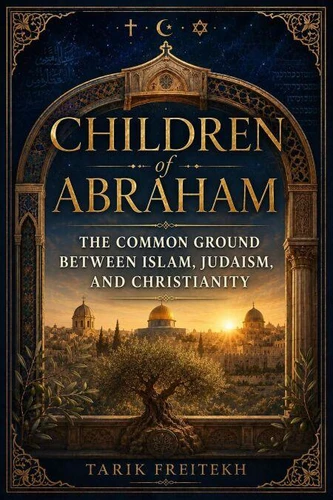
Three religions. One family. Four thousand years of shared story - and honest disagreement. Stand on a rooftop in Jerusalem on a Friday evening and you will hear three calls to prayer overlapping in a single square mile: the muezzin, the church bells, and the siren announcing the Sabbath. A visitor might conclude that these three faiths are the same religion in three costumes - or that they are three armies in permanent war.
Both conclusions are wrong. Children of Abraham is a clear, warm, and rigorously fair guide to what Judaism, Christianity, and Islam actually share - and where they genuinely differ. Written for readers with no background in religion, it traces the family resemblance across twenty-two chapters: one God, one ancestor, overlapping scriptures and prophets, and the daily disciplines of prayer, fasting, charity, repentance, and hospitality that shape more than half of humanity.
But this is not a book that blurs distinctions to keep the peace. Every chapter pairs a section called "What They Share" with one called "Important Distinctions" - because respect built on pretending is no respect at all. You will find the Trinity explained accurately rather than caricatured, the meanings of sharia and jihad laid out as Muslim scholars understand them, chosenness explained as vocation rather than privilege, and the real, unresolved disagreements about Jesus, Muhammad, scripture, and salvation stated plainly.
Inside you'll discover: Why Abraham is claimed as father by all three faiths - and why they disagree about which son climbed the mountain How the Shema, the Nicene Creed, and the shahada each proclaim one God in three different grammars What Yom Kippur, Lent, and Ramadan are actually doing - and why similar fasts carry different meanings The shared ethics of charity, mercy, peace, education, the environment, and care for the stranger An honest account of fourteen centuries of coexistence and persecution - with neither the golden-age myth nor the eternal-conflict myth Calm corrections of the misunderstandings each community holds about the others Practical tools for respectful conversation across faiths, drawn from decades of interfaith practice Balanced, compassionate, and never proselytizing, Children of Abraham argues that accurate kinship is a better foundation for coexistence than either forced sameness or fearful ignorance.
It includes a glossary of Hebrew, Greek, and Arabic terms, a four-thousand-year comparative timeline, discussion questions in every chapter, and a guide for book clubs and interfaith study groups. For anyone with Jewish, Christian, or Muslim neighbors, colleagues, in-laws, or friends - and for anyone who wants to understand the news, the history, and the human beings behind three of the world's great faiths.
Three religions. One family. Four thousand years of shared story - and honest disagreement. Stand on a rooftop in Jerusalem on a Friday evening and you will hear three calls to prayer overlapping in a single square mile: the muezzin, the church bells, and the siren announcing the Sabbath. A visitor might conclude that these three faiths are the same religion in three costumes - or that they are three armies in permanent war.
Both conclusions are wrong. Children of Abraham is a clear, warm, and rigorously fair guide to what Judaism, Christianity, and Islam actually share - and where they genuinely differ. Written for readers with no background in religion, it traces the family resemblance across twenty-two chapters: one God, one ancestor, overlapping scriptures and prophets, and the daily disciplines of prayer, fasting, charity, repentance, and hospitality that shape more than half of humanity.
But this is not a book that blurs distinctions to keep the peace. Every chapter pairs a section called "What They Share" with one called "Important Distinctions" - because respect built on pretending is no respect at all. You will find the Trinity explained accurately rather than caricatured, the meanings of sharia and jihad laid out as Muslim scholars understand them, chosenness explained as vocation rather than privilege, and the real, unresolved disagreements about Jesus, Muhammad, scripture, and salvation stated plainly.
Inside you'll discover: Why Abraham is claimed as father by all three faiths - and why they disagree about which son climbed the mountain How the Shema, the Nicene Creed, and the shahada each proclaim one God in three different grammars What Yom Kippur, Lent, and Ramadan are actually doing - and why similar fasts carry different meanings The shared ethics of charity, mercy, peace, education, the environment, and care for the stranger An honest account of fourteen centuries of coexistence and persecution - with neither the golden-age myth nor the eternal-conflict myth Calm corrections of the misunderstandings each community holds about the others Practical tools for respectful conversation across faiths, drawn from decades of interfaith practice Balanced, compassionate, and never proselytizing, Children of Abraham argues that accurate kinship is a better foundation for coexistence than either forced sameness or fearful ignorance.
It includes a glossary of Hebrew, Greek, and Arabic terms, a four-thousand-year comparative timeline, discussion questions in every chapter, and a guide for book clubs and interfaith study groups. For anyone with Jewish, Christian, or Muslim neighbors, colleagues, in-laws, or friends - and for anyone who wants to understand the news, the history, and the human beings behind three of the world's great faiths.

 , qui est-ce ?