Sam McKegney is a settler scholar of Indigenous literatures and is Professor and Head of the Department of English at Queen's University in the territory of the Haudenosaunee and Anishinaabe Peoples. He has published two books-Masculindians: Conversations about Indigenous Manhood and Magic Weapons: Aboriginal Writers Remaking Community after Residential School-and articles on such topics as masculinity, environmental kinship, prison writing, and mythologies of hockey.
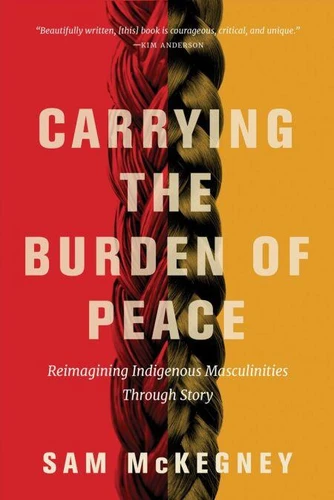
Carrying the Burden of Peace. Reimagining Indigenous Masculinities Through Story
Par :Formats :
Disponible dans votre compte client Decitre ou Furet du Nord dès validation de votre commande. Le format ePub est :
- Compatible avec une lecture sur My Vivlio (smartphone, tablette, ordinateur)
- Compatible avec une lecture sur liseuses Vivlio
- Pour les liseuses autres que Vivlio, vous devez utiliser le logiciel Adobe Digital Edition. Non compatible avec la lecture sur les liseuses Kindle, Remarkable et Sony
 , qui est-ce ?
Notre partenaire de plateforme de lecture numérique où vous retrouverez l'ensemble de vos ebooks gratuitement
Pour en savoir plus sur nos ebooks, consultez notre aide en ligne ici
C'est si simple ! Lisez votre ebook avec l'app Vivlio sur votre tablette, mobile ou ordinateur :

- Nombre de pages288
- FormatePub
- ISBN978-0-88977-797-2
- EAN9780889777972
- Date de parution24/04/2021
- Protection num.Digital Watermarking
- Taille6 Mo
- Infos supplémentairesepub
- ÉditeurUniversity of Regina Press
Résumé
Can a critical examination of Indigenous masculinities be an honour song-one that celebrates rather than pathologizes; one that seeks diversity and strength; one that overturns heteropatriarchy without centering settler colonialism? Can a critical examination of Indigenous masculinities even be creative, inclusive, erotic? Carrying the Burden of Peace answers affirmatively. Countering the perception that "masculinity" has been so contaminated as to be irredeemable, the book explores Indigenous literary art for understandings of masculinity that exceed the impoverished inheritance of colonialism.
Sam McKegney's argument is simple: if we understand that masculinity pertains to maleness, and that there are those within Indigenous families, communities and nations who identify as male, then the concession that masculinity concerns only negative characteristics bears stark consequences. It would mean that the resources available to affirm those subjectivities will be constrained, and perhaps even contaminated by shame.
Indigenous masculinities are more than what settler colonialism has told us. To deny the beauty, vulnerability, and grace that can be expressed and experienced as masculinity is to concede to settler colonialism's limiting vision of the world; it is to eschew the creativity that is among our greatest strengths. Carrying the Burden of Peace weaves together stories of Indigenous life, love, eroticism, pain, and joy to map the contours of diverse, empowered, and non-dominative Indigenous masculinities.
It is from here that a more balanced world may be pursued.
Sam McKegney's argument is simple: if we understand that masculinity pertains to maleness, and that there are those within Indigenous families, communities and nations who identify as male, then the concession that masculinity concerns only negative characteristics bears stark consequences. It would mean that the resources available to affirm those subjectivities will be constrained, and perhaps even contaminated by shame.
Indigenous masculinities are more than what settler colonialism has told us. To deny the beauty, vulnerability, and grace that can be expressed and experienced as masculinity is to concede to settler colonialism's limiting vision of the world; it is to eschew the creativity that is among our greatest strengths. Carrying the Burden of Peace weaves together stories of Indigenous life, love, eroticism, pain, and joy to map the contours of diverse, empowered, and non-dominative Indigenous masculinities.
It is from here that a more balanced world may be pursued.