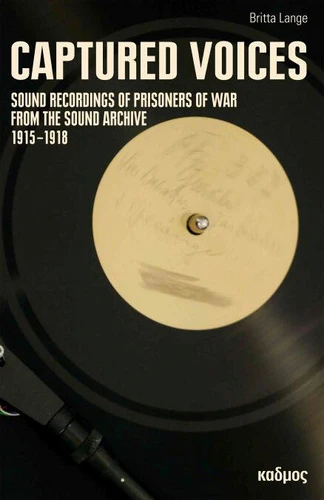
Captured Voices. Sound Recordings of Prisoners of War from the Sound Archive 1915 - 1918
Par : ,Formats :
Disponible dans votre compte client Decitre ou Furet du Nord dès validation de votre commande. Le format PDF est :
- Compatible avec une lecture sur My Vivlio (smartphone, tablette, ordinateur)
- Compatible avec une lecture sur liseuses Vivlio
- Pour les liseuses autres que Vivlio, vous devez utiliser le logiciel Adobe Digital Edition. Non compatible avec la lecture sur les liseuses Kindle, Remarkable et Sony
 , qui est-ce ?
Notre partenaire de plateforme de lecture numérique où vous retrouverez l'ensemble de vos ebooks gratuitement
Pour en savoir plus sur nos ebooks, consultez notre aide en ligne ici
C'est si simple ! Lisez votre ebook avec l'app Vivlio sur votre tablette, mobile ou ordinateur :

- Nombre de pages400
- FormatPDF
- ISBN978-3-96750-008-0
- EAN9783967500080
- Date de parution15/08/2022
- Protection num.Digital Watermarking
- Taille140 Mo
- Infos supplémentairespdf
- ÉditeurKulturverlag Kadmos Berlin
Résumé
»In the land of Germany, they don't understand a word, and I don't speak in shame.« These words were sung by Jasbahadur Rai on 6th June 1916 into the funnel of a gramophone. As an Indian colonial soldier of the British Army, he was located in a prisoner of war camp in Wünsdorf, not far from Berlin in Germany, at the time of his sound recording. He sang in his language about how he perceived Germany, and at the same time that he hardly dared to speak.
To whom did he speak when he raised his voice nonetheless? The cultural studies scholar Britta Lange researched sound recordings of male prisoners of war from the Sound Archive of the Humboldt University of Berlin produced in German camps during the First World War by scientists of the Royal Prussian Phonographic Commission. In this book, she traces the voices that are preserved today on shellac records.
Each chapter constitutes a new encounter and raises complex questions: How can the historical testimonies not only be heard but also be listened to today? And what forms of translation do they demand? Captured in multiple ways, the voices in this comprehensive study not only reveal their historical making as sound recordings, but also reflect contemporary interpretations of archival and scholarly practice. The English e-book includes a streaming feature for the sound recordings co-produced by Britta Lange and Sebastian Schwesinger. It is translated from German by Dr.
Rubaica Jaliwala as part of a grant from the Deutscher Übersetzerfonds.
To whom did he speak when he raised his voice nonetheless? The cultural studies scholar Britta Lange researched sound recordings of male prisoners of war from the Sound Archive of the Humboldt University of Berlin produced in German camps during the First World War by scientists of the Royal Prussian Phonographic Commission. In this book, she traces the voices that are preserved today on shellac records.
Each chapter constitutes a new encounter and raises complex questions: How can the historical testimonies not only be heard but also be listened to today? And what forms of translation do they demand? Captured in multiple ways, the voices in this comprehensive study not only reveal their historical making as sound recordings, but also reflect contemporary interpretations of archival and scholarly practice. The English e-book includes a streaming feature for the sound recordings co-produced by Britta Lange and Sebastian Schwesinger. It is translated from German by Dr.
Rubaica Jaliwala as part of a grant from the Deutscher Übersetzerfonds.