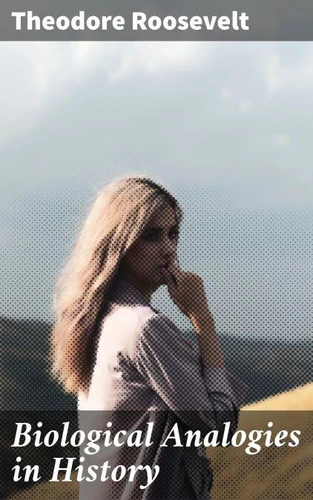
Biological Analogies in History. Unveiling Evolutionary Insights in Historical Narratives
Par :Formats :
Disponible dans votre compte client Decitre ou Furet du Nord dès validation de votre commande. Le format ePub est :
- Compatible avec une lecture sur My Vivlio (smartphone, tablette, ordinateur)
- Compatible avec une lecture sur liseuses Vivlio
- Pour les liseuses autres que Vivlio, vous devez utiliser le logiciel Adobe Digital Edition. Non compatible avec la lecture sur les liseuses Kindle, Remarkable et Sony
 , qui est-ce ?
Notre partenaire de plateforme de lecture numérique où vous retrouverez l'ensemble de vos ebooks gratuitement
Pour en savoir plus sur nos ebooks, consultez notre aide en ligne ici
C'est si simple ! Lisez votre ebook avec l'app Vivlio sur votre tablette, mobile ou ordinateur :

- Nombre de pages33
- FormatePub
- ISBN406-4-06-644335-1
- EAN4064066443351
- Date de parution11/04/2021
- Protection num.Digital Watermarking
- Taille458 Ko
- Infos supplémentairesepub
- ÉditeurGOOD PRESS
Résumé
In "Biological Analogies in History, " Theodore Roosevelt examines the interplay between biology and historical development, positing that the principles governing the natural world can provide profound insights into societal evolution. The book employs a rich, analytical prose style, interweaving historical events with biological concepts to draw parallels and demonstrate the interconnectedness of life and societal progress.
Contextually, it emerges during a period of heightened interest in social Darwinism and the burgeoning field of ecology, reflecting Roosevelt'Äôs unique perspective as a naturalist and historian, while also challenging the deterministic interpretations of evolution in societal dynamics. Theodore Roosevelt, the 26th President of the United States, was a passionate advocate for conservation and the natural sciences, which profoundly shaped his worldview.
His diverse experiences'Äîas a rancher, soldier, and politician'Äîfostered a deep understanding of the struggles inherent in both nature and human societies. This duality in his life experiences inspired him to explore the implications of biological thought on human history, particularly during a time when industrialization and urbanization were radically transforming American life. I highly recommend "Biological Analogies in History" to readers seeking a thought-provoking exploration of history viewed through a biological lens.
Roosevelt's distinctive insights serve not only as an enlightening historical study but also as a timeless commentary on human behavior and the evolution of societies.
Contextually, it emerges during a period of heightened interest in social Darwinism and the burgeoning field of ecology, reflecting Roosevelt'Äôs unique perspective as a naturalist and historian, while also challenging the deterministic interpretations of evolution in societal dynamics. Theodore Roosevelt, the 26th President of the United States, was a passionate advocate for conservation and the natural sciences, which profoundly shaped his worldview.
His diverse experiences'Äîas a rancher, soldier, and politician'Äîfostered a deep understanding of the struggles inherent in both nature and human societies. This duality in his life experiences inspired him to explore the implications of biological thought on human history, particularly during a time when industrialization and urbanization were radically transforming American life. I highly recommend "Biological Analogies in History" to readers seeking a thought-provoking exploration of history viewed through a biological lens.
Roosevelt's distinctive insights serve not only as an enlightening historical study but also as a timeless commentary on human behavior and the evolution of societies.
A propos de Theodore Roosevelt


0,99 €