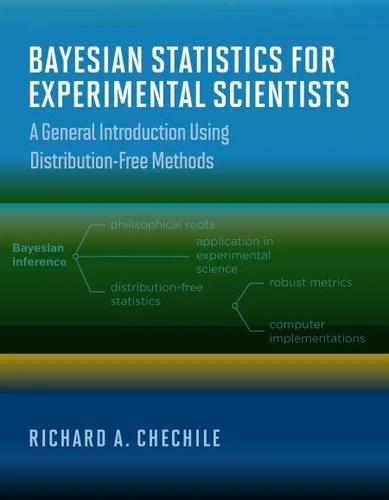
Bayesian Statistics for Experimental Scientists. A General Introduction Using Distribution-Free Methods
Par :Formats :
Disponible dans votre compte client Decitre ou Furet du Nord dès validation de votre commande. Le format ePub protégé est :
- Compatible avec une lecture sur My Vivlio (smartphone, tablette, ordinateur)
- Compatible avec une lecture sur liseuses Vivlio
- Pour les liseuses autres que Vivlio, vous devez utiliser le logiciel Adobe Digital Edition. Non compatible avec la lecture sur les liseuses Kindle, Remarkable et Sony
- Non compatible avec un achat hors France métropolitaine
 , qui est-ce ?
Notre partenaire de plateforme de lecture numérique où vous retrouverez l'ensemble de vos ebooks gratuitement
Pour en savoir plus sur nos ebooks, consultez notre aide en ligne ici
C'est si simple ! Lisez votre ebook avec l'app Vivlio sur votre tablette, mobile ou ordinateur :

- Nombre de pages512
- FormatePub
- ISBN978-0-262-36070-8
- EAN9780262360708
- Date de parution08/09/2020
- Protection num.Adobe DRM
- Taille15 Mo
- Infos supplémentairesepub
- ÉditeurThe MIT Press
Résumé
An introduction to the Bayesian approach to statistical inference that demonstrates its superiority to orthodox frequentist statistical analysis. This book offers an introduction to the Bayesian approach to statistical inference, with a focus on nonparametric and distribution-free methods. It covers not only well-developed methods for doing Bayesian statistics but also novel tools that enable Bayesian statistical analyses for cases that previously did not have a full Bayesian solution.
The book's premise is that there are fundamental problems with orthodox frequentist statistical analyses that distort the scientific process. Side-by-side comparisons of Bayesian and frequentist methods illustrate the mismatch between the needs of experimental scientists in making inferences from data and the properties of the standard tools of classical statistics.
The book's premise is that there are fundamental problems with orthodox frequentist statistical analyses that distort the scientific process. Side-by-side comparisons of Bayesian and frequentist methods illustrate the mismatch between the needs of experimental scientists in making inferences from data and the properties of the standard tools of classical statistics.