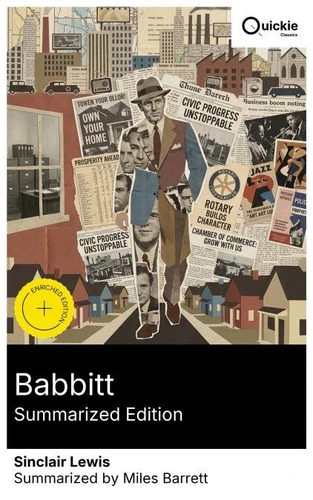
Babbitt (Summarized Edition). Enriched edition. A 1920s American character study of middle-class conformity, social climbing, and the ethics of real estate and business
Par : ,Formats :
Disponible dans votre compte client Decitre ou Furet du Nord dès validation de votre commande. Le format ePub est :
- Compatible avec une lecture sur My Vivlio (smartphone, tablette, ordinateur)
- Compatible avec une lecture sur liseuses Vivlio
- Pour les liseuses autres que Vivlio, vous devez utiliser le logiciel Adobe Digital Edition. Non compatible avec la lecture sur les liseuses Kindle, Remarkable et Sony
 , qui est-ce ?
Notre partenaire de plateforme de lecture numérique où vous retrouverez l'ensemble de vos ebooks gratuitement
Pour en savoir plus sur nos ebooks, consultez notre aide en ligne ici
C'est si simple ! Lisez votre ebook avec l'app Vivlio sur votre tablette, mobile ou ordinateur :

- Nombre de pages121
- FormatePub
- ISBN859-65--4788221-3
- EAN8596547882213
- Date de parution10/01/2026
- Protection num.Digital Watermarking
- Taille887 Ko
- Infos supplémentairesepub
- ÉditeurQUICKIE CLASSICS
Résumé
Published in 1922, Babbitt is Sinclair Lewis's incisive anatomy of American middle-class life, following George F. Babbitt, a prosperous real-estate broker in the bustling, fictional city of Zenith. With merciless irony and sympathetic nuance, Lewis catalogs Rotary luncheons, sales patter, gadgets, and civic boosterism, tracing how consumer spectacle and clubby conformity shape desires and speech.
A brief rebellion-flirtations with bohemian circles, a love affair, and dabbling in liberal politics-only throws the gravitational pull of respectability into relief. Written in brisk, idiomatic prose and deft free indirect discourse, the novel stands as a central satire of the Roaring Twenties; "Babbittry" entered the language. Lewis, raised in Sauk Centre, Minnesota, honed his satirist's eye in journalism and publishing before turning to fiction; after Main Street (1920) skewered small-town provincialism, he turned to the metropolitan business class.
For Babbitt he steeped himself in trade journals, salesmanship manuals, and businessmen's clubs, observing Rotary rhetoric and chamber-of-commerce optimism. His muckraking sympathies and realist craft, later recognized by the 1930 Nobel Prize, animate the novel's blend of documentary detail and psychological insight. Readers of American literature, cultural history, or business ethics will find Babbitt indispensable-acerbic, humane, and enduringly relevant to modern consumer democracies. Quickie Classics summarizes timeless works with precision, preserving the author's voice and keeping the prose clear, fast, and readable-distilled, never diluted.
Enriched Edition extras: Introduction · Synopsis · Historical Context · Author Biography · Brief Analysis · 4 Reflection Q&As · Editorial Footnotes.
A brief rebellion-flirtations with bohemian circles, a love affair, and dabbling in liberal politics-only throws the gravitational pull of respectability into relief. Written in brisk, idiomatic prose and deft free indirect discourse, the novel stands as a central satire of the Roaring Twenties; "Babbittry" entered the language. Lewis, raised in Sauk Centre, Minnesota, honed his satirist's eye in journalism and publishing before turning to fiction; after Main Street (1920) skewered small-town provincialism, he turned to the metropolitan business class.
For Babbitt he steeped himself in trade journals, salesmanship manuals, and businessmen's clubs, observing Rotary rhetoric and chamber-of-commerce optimism. His muckraking sympathies and realist craft, later recognized by the 1930 Nobel Prize, animate the novel's blend of documentary detail and psychological insight. Readers of American literature, cultural history, or business ethics will find Babbitt indispensable-acerbic, humane, and enduringly relevant to modern consumer democracies. Quickie Classics summarizes timeless works with precision, preserving the author's voice and keeping the prose clear, fast, and readable-distilled, never diluted.
Enriched Edition extras: Introduction · Synopsis · Historical Context · Author Biography · Brief Analysis · 4 Reflection Q&As · Editorial Footnotes.