The Anthropocene is not simply a scientific label. It is a shift in power, geography, and responsibility. Human activity now shapes climate systems, redraws coastlines, disrupts biodiversity networks, and alters the chemistry of the atmosphere. But while the planet transforms, policy remains fragmented, economic models lag behind ecological realities, and institutions struggle to govern forces that operate at planetary scale.
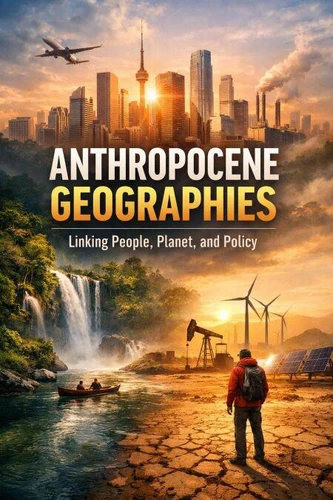
Anthropocene Geographies: Linking People, Planet, and Policy reframes this moment as a spatial and governance revolution. It examines Earth systems as infrastructure, climate risk as financial architecture, and territory as a dynamic field shaped by carbon flows, migration corridors, mineral extraction, urban heat, and water conflict. This is not a book about abstract environmental concern. It is a professional manual for understanding how power operates in a destabilized world.
Inside, readers will examine:· How carbon supply chains reorganize global inequality· Why renewable energy is reshaping territorial politics· How climate migration will redefine borders and sovereignty· What climate finance means for cities, sovereign bonds, and infrastructure· How biodiversity corridors and ocean governance determine geopolitical stability· Why polycentric governance is emerging as a dominant political formBridging geospatial science, political economy, risk analysis, and institutional design, this book equips policymakers, planners, investors, scholars, and corporate leaders with the conceptual tools required to operate in a planet defined by feedback loops and cascading risk.
The future will not be managed by those who think locally while systems operate globally. It will be shaped by professionals who understand how geography, governance, and planetary processes intersect. This book prepares you to be one of them.
The Anthropocene is not simply a scientific label. It is a shift in power, geography, and responsibility. Human activity now shapes climate systems, redraws coastlines, disrupts biodiversity networks, and alters the chemistry of the atmosphere. But while the planet transforms, policy remains fragmented, economic models lag behind ecological realities, and institutions struggle to govern forces that operate at planetary scale.
Anthropocene Geographies: Linking People, Planet, and Policy reframes this moment as a spatial and governance revolution. It examines Earth systems as infrastructure, climate risk as financial architecture, and territory as a dynamic field shaped by carbon flows, migration corridors, mineral extraction, urban heat, and water conflict. This is not a book about abstract environmental concern. It is a professional manual for understanding how power operates in a destabilized world.
Inside, readers will examine:· How carbon supply chains reorganize global inequality· Why renewable energy is reshaping territorial politics· How climate migration will redefine borders and sovereignty· What climate finance means for cities, sovereign bonds, and infrastructure· How biodiversity corridors and ocean governance determine geopolitical stability· Why polycentric governance is emerging as a dominant political formBridging geospatial science, political economy, risk analysis, and institutional design, this book equips policymakers, planners, investors, scholars, and corporate leaders with the conceptual tools required to operate in a planet defined by feedback loops and cascading risk.
The future will not be managed by those who think locally while systems operate globally. It will be shaped by professionals who understand how geography, governance, and planetary processes intersect. This book prepares you to be one of them.


 , qui est-ce ?