
Nouveauté
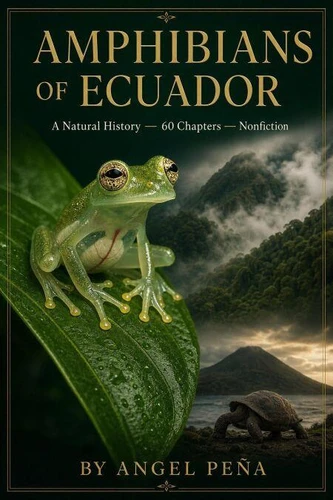
AMPHIBIANS OF ECUADOR
Par :Formats :
Disponible dans votre compte client Decitre ou Furet du Nord dès validation de votre commande. Le format ePub est :
- Compatible avec une lecture sur My Vivlio (smartphone, tablette, ordinateur)
- Compatible avec une lecture sur liseuses Vivlio
- Pour les liseuses autres que Vivlio, vous devez utiliser le logiciel Adobe Digital Edition. Non compatible avec la lecture sur les liseuses Kindle, Remarkable et Sony
 , qui est-ce ?
Notre partenaire de plateforme de lecture numérique où vous retrouverez l'ensemble de vos ebooks gratuitement
Pour en savoir plus sur nos ebooks, consultez notre aide en ligne ici
C'est si simple ! Lisez votre ebook avec l'app Vivlio sur votre tablette, mobile ou ordinateur :

- FormatePub
- ISBN8235757943
- EAN9798235757943
- Date de parution01/08/2026
- Protection num.pas de protection
- Infos supplémentairesepub
- ÉditeurIoakim Ioakim
Résumé
AMPHIBIANS OF ECUADOR: A NATURAL HISTORYAmphibians of Ecuador: A Natural History is a scientifically informed exploration of one of the most extraordinary amphibian faunas on Earth. Although Ecuador is relatively small in geographic size, its position along the equator, dramatic Andean elevations, Pacific ecosystems, Amazonian forests, and complex network of rivers and wetlands have created exceptional conditions for amphibian diversification.
The book examines Ecuador's amphibians through the landscapes they inhabit and the evolutionary processes that have shaped them. From the humid lowland forests of the Amazon to Andean cloud forests, páramo environments, Pacific dry forests, wetlands, streams, and other specialized habitats, the work explores how frogs, toads, salamanders, and caecilians survive in environments that can change dramatically over surprisingly short distances.
The book also examines the biological characteristics that make amphibians particularly important to ecological science. Their dependence on moisture, sensitivity to environmental change, complex reproductive strategies, specialized behaviors, and close relationship with aquatic and terrestrial ecosystems make them valuable subjects for understanding biodiversity and ecosystem health. A major theme is the extraordinary endemism found in Ecuador, particularly in the Andes, where mountains, valleys, elevation gradients, and geographic isolation have contributed to the evolution of highly specialized amphibian lineages.
The book considers how these evolutionary processes have produced remarkable diversity while simultaneously making many species vulnerable to habitat loss, climate change, disease, pollution, altered hydrology, and other environmental pressures. Conservation is therefore central to the work. Amphibians of Ecuador considers the challenges facing Ecuadorian amphibians and the importance of protected areas, scientific research, habitat preservation, restoration, monitoring, and cooperation among scientists, conservationists, governments, and local communities.
Written for naturalists, students, wildlife enthusiasts, ecotourists, conservationists, and educated general readers, the book combines accessible natural-history writing with scientifically responsible discussion. It does not present itself as a definitive taxonomic catalog; rather, it offers a broad natural-history perspective on Ecuador's amphibians and the environments that sustain them. Ultimately, the book presents Ecuador's amphibians not simply as individual species, but as living representatives of evolutionary history and as indicators of the health of the ecosystems upon which countless other organisms-including humans-depend.
The book examines Ecuador's amphibians through the landscapes they inhabit and the evolutionary processes that have shaped them. From the humid lowland forests of the Amazon to Andean cloud forests, páramo environments, Pacific dry forests, wetlands, streams, and other specialized habitats, the work explores how frogs, toads, salamanders, and caecilians survive in environments that can change dramatically over surprisingly short distances.
The book also examines the biological characteristics that make amphibians particularly important to ecological science. Their dependence on moisture, sensitivity to environmental change, complex reproductive strategies, specialized behaviors, and close relationship with aquatic and terrestrial ecosystems make them valuable subjects for understanding biodiversity and ecosystem health. A major theme is the extraordinary endemism found in Ecuador, particularly in the Andes, where mountains, valleys, elevation gradients, and geographic isolation have contributed to the evolution of highly specialized amphibian lineages.
The book considers how these evolutionary processes have produced remarkable diversity while simultaneously making many species vulnerable to habitat loss, climate change, disease, pollution, altered hydrology, and other environmental pressures. Conservation is therefore central to the work. Amphibians of Ecuador considers the challenges facing Ecuadorian amphibians and the importance of protected areas, scientific research, habitat preservation, restoration, monitoring, and cooperation among scientists, conservationists, governments, and local communities.
Written for naturalists, students, wildlife enthusiasts, ecotourists, conservationists, and educated general readers, the book combines accessible natural-history writing with scientifically responsible discussion. It does not present itself as a definitive taxonomic catalog; rather, it offers a broad natural-history perspective on Ecuador's amphibians and the environments that sustain them. Ultimately, the book presents Ecuador's amphibians not simply as individual species, but as living representatives of evolutionary history and as indicators of the health of the ecosystems upon which countless other organisms-including humans-depend.
A propos de angel peña


4,49 €


4,49 €

4,49 €


4,49 €


3,99 €

Steel Hearts
E-book
4,49 €

4,49 €

4,49 €

4,49 €

4,49 €

The Night of the Abyss
E-book
4,49 €

2,99 €

Hearts Unbound
E-book
2,99 €