Drawing on forty years of clinical practice and thirty-four years as medical director of a nonprofit serving underprivileged populations across the full age range, Dr. Ravinder Nath Bhalla makes a diagnosis and writes a prescription. The diagnosis: American healthcare costs more than any system in the world and produces worse outcomes than any developed country, not because the money is missing or the clinical knowledge is missing, but because the constitutional floor was never built.
The United States is the only developed country without a recognized affirmative state duty to care for its citizens. The result is a system that extracts margin from sickness rather than investing in health, that rewards billable interventions over prevention, that breaks the physicians it claims to revere, and that lets Type 1 diabetics die rationing insulin while the executives of the companies that priced the insulin out of reach take home eight-figure compensation. The book traces the failure with specificity.
Alec Smith, dead at twenty-six. Robert Allen in rural Kentucky, watching his vascular system fail because the hospital closed. Trishaun Holland, boarded in an emergency department for sixteen days waiting for a psychiatric bed that did not exist. One hundred and forty-six rural hospitals have closed since 2010. Four hundred and thirty-two more are at risk. The collapse the title names is not theoretical.
It is in progress. The prescription is not a policy adjustment. It is a constitutional rebuild - the establishment of the floor that other developed countries built decades or centuries ago, from Bismarck's Germany in 1883 through Britain's NHS in 1948 to Taiwan's two-year single-payer transition in the 1990s. Every one of these countries faced the same opposition that American opponents raise today.
Every one made the decision anyway. The United States has not yet made this decision. Not because the decision is impossible. Because the political conditions that would make it politically possible have not yet been built. The book engages the serious philosophical objection from the Objectivist tradition - Ayn Rand and Leonard Peikoff - and shows what their argument got right (the dangers of administrative capture of physician judgment) and what it got wrong (the absence of any state duty to the citizen).
It draws on Kenneth Arrow's foundational 1963 analysis showing why healthcare cannot function as a normal market. It traces the constitutional hole through DeShaney and Castle Rock - the Supreme Court cases that established the United States as the developed world's outlier in refusing to recognize state duty. For physicians, hospital administrators, policy professionals, patients, and citizens who suspect that the current debate has been small and the deeper problem has been left unnamed, this book names the deeper problem and provides a map for the rebuild.
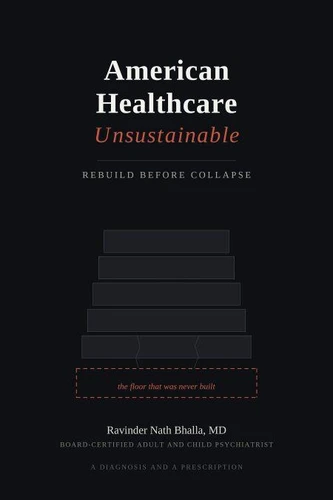
Drawing on forty years of clinical practice and thirty-four years as medical director of a nonprofit serving underprivileged populations across the full age range, Dr. Ravinder Nath Bhalla makes a diagnosis and writes a prescription. The diagnosis: American healthcare costs more than any system in the world and produces worse outcomes than any developed country, not because the money is missing or the clinical knowledge is missing, but because the constitutional floor was never built.
The United States is the only developed country without a recognized affirmative state duty to care for its citizens. The result is a system that extracts margin from sickness rather than investing in health, that rewards billable interventions over prevention, that breaks the physicians it claims to revere, and that lets Type 1 diabetics die rationing insulin while the executives of the companies that priced the insulin out of reach take home eight-figure compensation. The book traces the failure with specificity.
Alec Smith, dead at twenty-six. Robert Allen in rural Kentucky, watching his vascular system fail because the hospital closed. Trishaun Holland, boarded in an emergency department for sixteen days waiting for a psychiatric bed that did not exist. One hundred and forty-six rural hospitals have closed since 2010. Four hundred and thirty-two more are at risk. The collapse the title names is not theoretical.
It is in progress. The prescription is not a policy adjustment. It is a constitutional rebuild - the establishment of the floor that other developed countries built decades or centuries ago, from Bismarck's Germany in 1883 through Britain's NHS in 1948 to Taiwan's two-year single-payer transition in the 1990s. Every one of these countries faced the same opposition that American opponents raise today.
Every one made the decision anyway. The United States has not yet made this decision. Not because the decision is impossible. Because the political conditions that would make it politically possible have not yet been built. The book engages the serious philosophical objection from the Objectivist tradition - Ayn Rand and Leonard Peikoff - and shows what their argument got right (the dangers of administrative capture of physician judgment) and what it got wrong (the absence of any state duty to the citizen).
It draws on Kenneth Arrow's foundational 1963 analysis showing why healthcare cannot function as a normal market. It traces the constitutional hole through DeShaney and Castle Rock - the Supreme Court cases that established the United States as the developed world's outlier in refusing to recognize state duty. For physicians, hospital administrators, policy professionals, patients, and citizens who suspect that the current debate has been small and the deeper problem has been left unnamed, this book names the deeper problem and provides a map for the rebuild.

 , qui est-ce ?