Core Thesis of the Book Agile Product Manager by Derek Abishua is not about shipping features but driving measurable outcomes through strategic discipline. The role requires influence without authority, operating at the intersection of customer needs, business viability, and technical feasibility. Key Frameworks1. Product Lifecycle Operating Model: Four continuous phases-Discover (problem validation), Define (solution design), Deliver (build/launch), Optimize (measure/iterate)-that de-risk development and institutionalize learning.2.
Market-Back Strategy: Winning products begin outside the building. PMs must filter opportunities through three lenses: urgency (real customer pain), market size (viable economics), and unique advantage (defensible moat).3. Prioritization Economics: Every decision carries an opportunity cost. High-impact PMs use frameworks like RICE (Reach, Impact, Confidence, Effort) and treat roadmaps as investment portfolios, focusing on outcomes over outputs.
Execution Excellence- Cross-functional alignment is engineered through shared problem definitions, not meetings. PMs must translate strategy for engineering (feasibility), design (usability), marketing (narrative), and finance (viability).- Metrics discipline focuses on four leading indicators: adoption (activation rate), engagement (habit formation), retention (cohort curves), and LTV/CAC (unit economics).
If a metric doesn't change decisions, it doesn't matter.- Experimentation mindset transforms opinions into falsifiable hypotheses. High-maturity cultures celebrate "kill rates" (killing bad ideas early) and treat failed experiments as learning, not failure. Leadership MindsetFive traits distinguish great PMs: customer obsession (systematic user immersion), structured thinking (decomposing complexity), ownership mentality (no blame-shifting), bias for action (learning through doing), and learning agility (updating beliefs based on evidence).
Conclusion: In volatile markets, learning velocity-the ability to convert uncertainty into validated insight faster than competitors-is the only sustainable advantage. Agile PMs architect systems that make good decisions inevitable, not accidental.
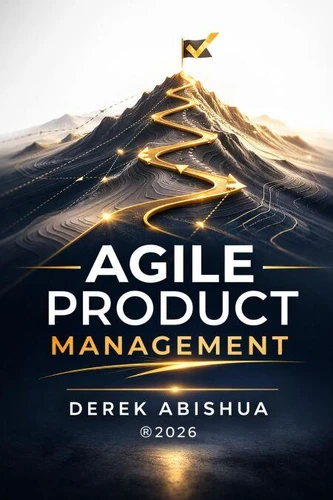
Core Thesis of the Book Agile Product Manager by Derek Abishua is not about shipping features but driving measurable outcomes through strategic discipline. The role requires influence without authority, operating at the intersection of customer needs, business viability, and technical feasibility. Key Frameworks1. Product Lifecycle Operating Model: Four continuous phases-Discover (problem validation), Define (solution design), Deliver (build/launch), Optimize (measure/iterate)-that de-risk development and institutionalize learning.2.
Market-Back Strategy: Winning products begin outside the building. PMs must filter opportunities through three lenses: urgency (real customer pain), market size (viable economics), and unique advantage (defensible moat).3. Prioritization Economics: Every decision carries an opportunity cost. High-impact PMs use frameworks like RICE (Reach, Impact, Confidence, Effort) and treat roadmaps as investment portfolios, focusing on outcomes over outputs.
Execution Excellence- Cross-functional alignment is engineered through shared problem definitions, not meetings. PMs must translate strategy for engineering (feasibility), design (usability), marketing (narrative), and finance (viability).- Metrics discipline focuses on four leading indicators: adoption (activation rate), engagement (habit formation), retention (cohort curves), and LTV/CAC (unit economics).
If a metric doesn't change decisions, it doesn't matter.- Experimentation mindset transforms opinions into falsifiable hypotheses. High-maturity cultures celebrate "kill rates" (killing bad ideas early) and treat failed experiments as learning, not failure. Leadership MindsetFive traits distinguish great PMs: customer obsession (systematic user immersion), structured thinking (decomposing complexity), ownership mentality (no blame-shifting), bias for action (learning through doing), and learning agility (updating beliefs based on evidence).
Conclusion: In volatile markets, learning velocity-the ability to convert uncertainty into validated insight faster than competitors-is the only sustainable advantage. Agile PMs architect systems that make good decisions inevitable, not accidental.

 , qui est-ce ?