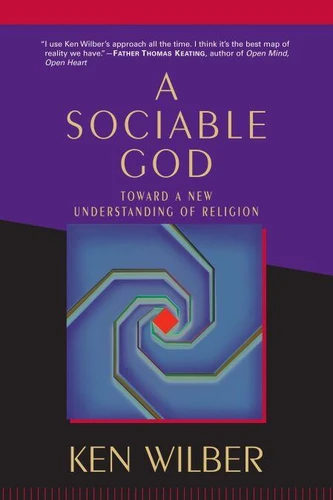
In one of the first attempts to bring an integral dimension to sociology, Ken Wilber introduces a system of reliable methods by which to make testable judgments of the authenticity of any religious movement. A Sociable God is a concise work based on Wilber's "spectrum of consciousness" theory, which views individual and cultural development as an evolutionary continuum. Here he focuses primarily on worldviews (archaic, magic, mythic, mental, psychic, subtle, causal, nondual) and evaluates various cultural and religious movements on a scale ranging from egocentric to ethnocentric to worldcentric to Kosmic.
By using this integral view, Wilber hopes, society would be able to discriminate between dangerous cults and authentic spiritual paths. In addition, he points out why these distinctions are crucial in understanding spiritual experiences and altered states of consciousness. In a lengthy new introduction, the author brings the reader up to date on his latest integral thinking and concludes that, for the succinct and elegant way it argues for a sociology of depth, A Sociable God remains a clarion call for a greater sociology.
In one of the first attempts to bring an integral dimension to sociology, Ken Wilber introduces a system of reliable methods by which to make testable judgments of the authenticity of any religious movement. A Sociable God is a concise work based on Wilber's "spectrum of consciousness" theory, which views individual and cultural development as an evolutionary continuum. Here he focuses primarily on worldviews (archaic, magic, mythic, mental, psychic, subtle, causal, nondual) and evaluates various cultural and religious movements on a scale ranging from egocentric to ethnocentric to worldcentric to Kosmic.
By using this integral view, Wilber hopes, society would be able to discriminate between dangerous cults and authentic spiritual paths. In addition, he points out why these distinctions are crucial in understanding spiritual experiences and altered states of consciousness. In a lengthy new introduction, the author brings the reader up to date on his latest integral thinking and concludes that, for the succinct and elegant way it argues for a sociology of depth, A Sociable God remains a clarion call for a greater sociology.


 , qui est-ce ?