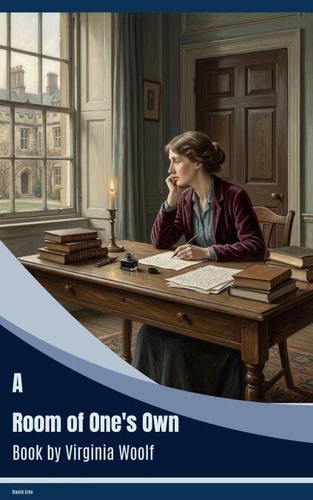
What does a woman need to create freely, think independently, and become a writer?
In A Room of One's Own, Virginia Woolf explores the social, economic, and educational barriers that have historically limited women's ability to write and develop their creative potential. Drawing from a series of lectures, Woolf combines literary criticism, fiction, history, and personal reflection to examine the relationship between gender, creativity, and independence.
Her central argument emphasizes the importance of financial security and personal space for creative work.
Woolf examines how women's exclusion from education, wealth, literary institutions, and intellectual life shaped the history of literature.
Through thought-provoking discussions of women writers, education, equality, artistic freedom, gender roles, and intellectual independence, Woolf challenges readers to reconsider whose voices are preserved in literary history.
First published in 1929, A Room of One's Own became one of the most influential works of feminist literature and modernist thought, remaining highly relevant to discussions of creativity and equality.
For readers interested in Virginia Woolf, feminist literature, women's studies, literary criticism, gender equality, creative writing, modernism, and social commentary, this classic offers a powerful and enduring perspective.
Discover Woolf's groundbreaking argument for women's intellectual and creative freedom.
Read A Room of One's Own today and explore the timeless connection between independence, equality, and creativity.
What does a woman need to create freely, think independently, and become a writer?
In A Room of One's Own, Virginia Woolf explores the social, economic, and educational barriers that have historically limited women's ability to write and develop their creative potential. Drawing from a series of lectures, Woolf combines literary criticism, fiction, history, and personal reflection to examine the relationship between gender, creativity, and independence.
Her central argument emphasizes the importance of financial security and personal space for creative work.
Woolf examines how women's exclusion from education, wealth, literary institutions, and intellectual life shaped the history of literature.
Through thought-provoking discussions of women writers, education, equality, artistic freedom, gender roles, and intellectual independence, Woolf challenges readers to reconsider whose voices are preserved in literary history.
First published in 1929, A Room of One's Own became one of the most influential works of feminist literature and modernist thought, remaining highly relevant to discussions of creativity and equality.
For readers interested in Virginia Woolf, feminist literature, women's studies, literary criticism, gender equality, creative writing, modernism, and social commentary, this classic offers a powerful and enduring perspective.
Discover Woolf's groundbreaking argument for women's intellectual and creative freedom.
Read A Room of One's Own today and explore the timeless connection between independence, equality, and creativity.

 , qui est-ce ?