- Accueil /
- Dr Ioannis S. Christodoulou
Dr Ioannis S. Christodoulou

Dernière sortie
Spinoza's Free Man
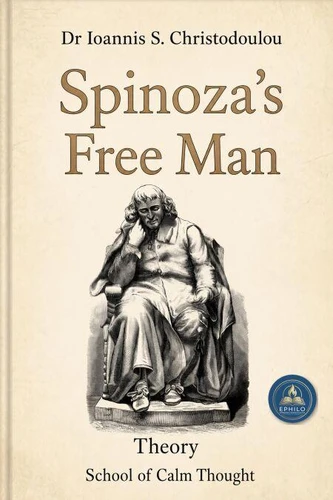
What does it mean to be free in a world governed by necessity?In Spinoza's Free Man, Dr Ioannis S. Christodoulou offers a rigorous and illuminating study of freedom, will, knowledge, and human action in the philosophy of Baruch Spinoza. Challenging the conventional belief that freedom consists in an unrestricted power of choice, the book explores Spinoza's radical claim that human beings are free not when they escape causality, but when they understand the causes that determine them.
The study follows the volitional element throughout Spinoza's work, examining the relationship between mind and body, will and understanding, reason and emotion, action and passion. Particular attention is given to Spinoza's three kinds of knowledge and to the decisive role of adequate ideas in the development of human power, virtue, and self-determination. The free person is therefore presented not as someone who acts without causes, but as someone who increasingly acts from an informed understanding of their own nature and of the wider order of Nature.
The book also considers the ethical and political consequences of this conception. Reason does not isolate the individual from others; it reveals that human flourishing depends upon cooperation, justice, trust, and the pursuit of a common good. Freedom thus becomes both an intellectual achievement and a practical way of life. Combining close textual analysis with a distinctive philosophical interpretation, Spinoza's Free Man presents Spinoza as a thinker of necessity who nevertheless preserves a meaningful conception of human agency.
Written for readers of philosophy, ethics, political thought, and intellectual history, this study invites us to reconsider some of the most enduring questions of human existence: What governs our actions? Can reason transform our emotions? And how may understanding lead us towards a freer life?
The study follows the volitional element throughout Spinoza's work, examining the relationship between mind and body, will and understanding, reason and emotion, action and passion. Particular attention is given to Spinoza's three kinds of knowledge and to the decisive role of adequate ideas in the development of human power, virtue, and self-determination. The free person is therefore presented not as someone who acts without causes, but as someone who increasingly acts from an informed understanding of their own nature and of the wider order of Nature.
The book also considers the ethical and political consequences of this conception. Reason does not isolate the individual from others; it reveals that human flourishing depends upon cooperation, justice, trust, and the pursuit of a common good. Freedom thus becomes both an intellectual achievement and a practical way of life. Combining close textual analysis with a distinctive philosophical interpretation, Spinoza's Free Man presents Spinoza as a thinker of necessity who nevertheless preserves a meaningful conception of human agency.
Written for readers of philosophy, ethics, political thought, and intellectual history, this study invites us to reconsider some of the most enduring questions of human existence: What governs our actions? Can reason transform our emotions? And how may understanding lead us towards a freer life?
What does it mean to be free in a world governed by necessity?In Spinoza's Free Man, Dr Ioannis S. Christodoulou offers a rigorous and illuminating study of freedom, will, knowledge, and human action in the philosophy of Baruch Spinoza. Challenging the conventional belief that freedom consists in an unrestricted power of choice, the book explores Spinoza's radical claim that human beings are free not when they escape causality, but when they understand the causes that determine them.
The study follows the volitional element throughout Spinoza's work, examining the relationship between mind and body, will and understanding, reason and emotion, action and passion. Particular attention is given to Spinoza's three kinds of knowledge and to the decisive role of adequate ideas in the development of human power, virtue, and self-determination. The free person is therefore presented not as someone who acts without causes, but as someone who increasingly acts from an informed understanding of their own nature and of the wider order of Nature.
The book also considers the ethical and political consequences of this conception. Reason does not isolate the individual from others; it reveals that human flourishing depends upon cooperation, justice, trust, and the pursuit of a common good. Freedom thus becomes both an intellectual achievement and a practical way of life. Combining close textual analysis with a distinctive philosophical interpretation, Spinoza's Free Man presents Spinoza as a thinker of necessity who nevertheless preserves a meaningful conception of human agency.
Written for readers of philosophy, ethics, political thought, and intellectual history, this study invites us to reconsider some of the most enduring questions of human existence: What governs our actions? Can reason transform our emotions? And how may understanding lead us towards a freer life?
The study follows the volitional element throughout Spinoza's work, examining the relationship between mind and body, will and understanding, reason and emotion, action and passion. Particular attention is given to Spinoza's three kinds of knowledge and to the decisive role of adequate ideas in the development of human power, virtue, and self-determination. The free person is therefore presented not as someone who acts without causes, but as someone who increasingly acts from an informed understanding of their own nature and of the wider order of Nature.
The book also considers the ethical and political consequences of this conception. Reason does not isolate the individual from others; it reveals that human flourishing depends upon cooperation, justice, trust, and the pursuit of a common good. Freedom thus becomes both an intellectual achievement and a practical way of life. Combining close textual analysis with a distinctive philosophical interpretation, Spinoza's Free Man presents Spinoza as a thinker of necessity who nevertheless preserves a meaningful conception of human agency.
Written for readers of philosophy, ethics, political thought, and intellectual history, this study invites us to reconsider some of the most enduring questions of human existence: What governs our actions? Can reason transform our emotions? And how may understanding lead us towards a freer life?
Les livres de Dr Ioannis S. Christodoulou
Nouveauté

7,99 €