Dernière sortie
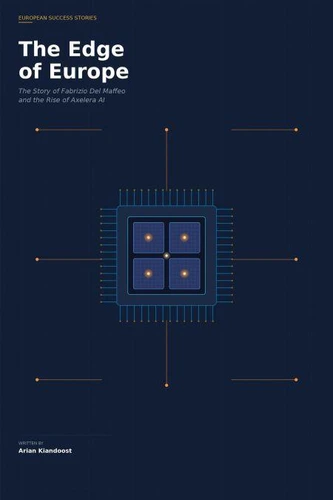
The Edge of Europe
Europe builds the machines that make the world's chips. It stopped building the chips. Every advanced semiconductor on earth passes through a machine made in the Netherlands. Yet when European factories, hospitals, and farms adopted artificial intelligence, the silicon running it came from Santa Clara, California - because Europe had no serious AI chip company of its own. In 2021, an Italian engineer in Eindhoven set out to change that.
The Edge of Europe is the story of Fabrizio Del Maffeo, who spent twenty years learning how hardware actually enters industry before co-founding Axelera AI - and of the researchers, from IBM Zurich to imec, who had spent a decade proving that a computer chip could think where its memory already sits. It is a story about a technical bet: that the biggest waste in artificial intelligence is not computation but the endless shuttling of data back and forth, and that whoever eliminates it owns the future of AI outside the data centre.
It is also a story about whether a continent that produces world-class research can still turn that research into industry - and what it costs to try. In this book: Why the memory wall is the real bottleneck in AI, and how computing inside memory sidesteps it How a startup taped out two working chips in twenty months when the industry standard is three to four years Why Eindhoven - the smartest square kilometre in Europe - was the only viable location The European Chips Act, and what sovereignty actually buys a company How Axelera reached 500 customers and the European Space Agency before most rivals shipped anything What it takes to compete with a company worth ten thousand times your total funding The Edge of Europe is the fourth book in the European Success Stories series - short, accessible books about European researchers and founders whose work created industries that did not exist before.
Each book stands alone. Also in the series: Mining Gold from Data, Robot Hands, and Entangled. Written for the curious, not the specialist. No engineering background required.
The Edge of Europe is the story of Fabrizio Del Maffeo, who spent twenty years learning how hardware actually enters industry before co-founding Axelera AI - and of the researchers, from IBM Zurich to imec, who had spent a decade proving that a computer chip could think where its memory already sits. It is a story about a technical bet: that the biggest waste in artificial intelligence is not computation but the endless shuttling of data back and forth, and that whoever eliminates it owns the future of AI outside the data centre.
It is also a story about whether a continent that produces world-class research can still turn that research into industry - and what it costs to try. In this book: Why the memory wall is the real bottleneck in AI, and how computing inside memory sidesteps it How a startup taped out two working chips in twenty months when the industry standard is three to four years Why Eindhoven - the smartest square kilometre in Europe - was the only viable location The European Chips Act, and what sovereignty actually buys a company How Axelera reached 500 customers and the European Space Agency before most rivals shipped anything What it takes to compete with a company worth ten thousand times your total funding The Edge of Europe is the fourth book in the European Success Stories series - short, accessible books about European researchers and founders whose work created industries that did not exist before.
Each book stands alone. Also in the series: Mining Gold from Data, Robot Hands, and Entangled. Written for the curious, not the specialist. No engineering background required.
Les livres de Arian Kiandoost
2,99 €