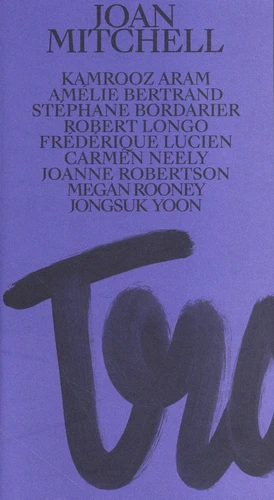
Joan Mitchell (1925-1992), l'une des artistes les plus importantes de l'après-guerre, est aussi une figure résolument transatlantique. A partir des années 1950, alors que Mitchell circule entre les Etats-Unis et la France, son oeuvre, et le discours qui l'entoure, se développent à travers deux continents, cieux cultures et deux langues. A l'invitation de Mara Hoberman, neuf artistes, vivant de part et d'autre de l'Atlantique, portent leurs regards sur sa vie, son oeuvre et son influence durable.
Joan Mitchell (1925-1992), one of the most important artists of the post-war period, is also a uniquely transatlantic figure. From the 1950s onward, as Mitchell shuttled back and forth between the United States and France, her work–and the discourse around it–developed across two continents, two cultures, and two languages. Invited by Mara Hoberman, nine artists, who are themselves based on either side of the Atlantic, reflect on Mitchell's life, work and enduring impact.
Joan Mitchell (1925-1992), l'une des artistes les plus importantes de l'après-guerre, est aussi une figure résolument transatlantique. A partir des années 1950, alors que Mitchell circule entre les Etats-Unis et la France, son oeuvre, et le discours qui l'entoure, se développent à travers deux continents, cieux cultures et deux langues. A l'invitation de Mara Hoberman, neuf artistes, vivant de part et d'autre de l'Atlantique, portent leurs regards sur sa vie, son oeuvre et son influence durable.
Joan Mitchell (1925-1992), one of the most important artists of the post-war period, is also a uniquely transatlantic figure. From the 1950s onward, as Mitchell shuttled back and forth between the United States and France, her work–and the discourse around it–developed across two continents, two cultures, and two languages. Invited by Mara Hoberman, nine artists, who are themselves based on either side of the Atlantic, reflect on Mitchell's life, work and enduring impact.