SOLDES
Jusqu'à -70% sur une sélection d'articles*
- Accueil /
- Mikal Abdul-Mateen
Mikal Abdul-Mateen

Dernière sortie
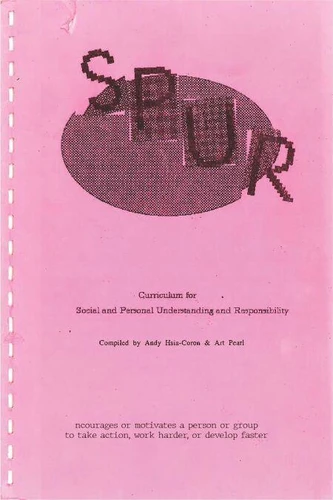
SPUR Curriculum for Social and Personal Understanding and Responsibility
The SPUR curriculum is designed holistically rather than linearly. In other words, every skill and problem is seen as related to every other skill and problem. The curriculum, therefore, emphasizes the need to keep circling back to the same set of problems, refining them each time. The SPUR curriculum primarily aims to achieve two educational goals. One is social cognitive competence, designed to help inmates become more sophisticated thinkers.
The other goal is for inmates to develop a workable post-release plan. Hence, the two goals are social competence and a realistic chance at succeeding on the streets. Key elements provided by the curriculum include problem-solving, meta-cognition, alternative reasoning, emotional management, impulse control, and perspective-taking. However, the social interaction strategy that is central to SPUR is cooperative learning.
Overall, the whole curriculum is a problem-solving curriculum. It is designed to solve one problem: to provide for a crime-free post-release existence, where the inmate will want to lead a new life that will not send him back to prison.
The other goal is for inmates to develop a workable post-release plan. Hence, the two goals are social competence and a realistic chance at succeeding on the streets. Key elements provided by the curriculum include problem-solving, meta-cognition, alternative reasoning, emotional management, impulse control, and perspective-taking. However, the social interaction strategy that is central to SPUR is cooperative learning.
Overall, the whole curriculum is a problem-solving curriculum. It is designed to solve one problem: to provide for a crime-free post-release existence, where the inmate will want to lead a new life that will not send him back to prison.
The SPUR curriculum is designed holistically rather than linearly. In other words, every skill and problem is seen as related to every other skill and problem. The curriculum, therefore, emphasizes the need to keep circling back to the same set of problems, refining them each time. The SPUR curriculum primarily aims to achieve two educational goals. One is social cognitive competence, designed to help inmates become more sophisticated thinkers.
The other goal is for inmates to develop a workable post-release plan. Hence, the two goals are social competence and a realistic chance at succeeding on the streets. Key elements provided by the curriculum include problem-solving, meta-cognition, alternative reasoning, emotional management, impulse control, and perspective-taking. However, the social interaction strategy that is central to SPUR is cooperative learning.
Overall, the whole curriculum is a problem-solving curriculum. It is designed to solve one problem: to provide for a crime-free post-release existence, where the inmate will want to lead a new life that will not send him back to prison.
The other goal is for inmates to develop a workable post-release plan. Hence, the two goals are social competence and a realistic chance at succeeding on the streets. Key elements provided by the curriculum include problem-solving, meta-cognition, alternative reasoning, emotional management, impulse control, and perspective-taking. However, the social interaction strategy that is central to SPUR is cooperative learning.
Overall, the whole curriculum is a problem-solving curriculum. It is designed to solve one problem: to provide for a crime-free post-release existence, where the inmate will want to lead a new life that will not send him back to prison.
Les livres de Mikal Abdul-Mateen

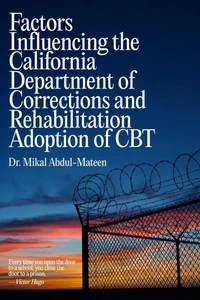
Factors Influencing the California Department of Corrections and Rehabilitation Adoption of CBT
Mikal Abdul-Mateen
E-book
4,49 €
