SOLDES
Jusqu'à -70% sur une sélection d'articles*
Dernière sortie
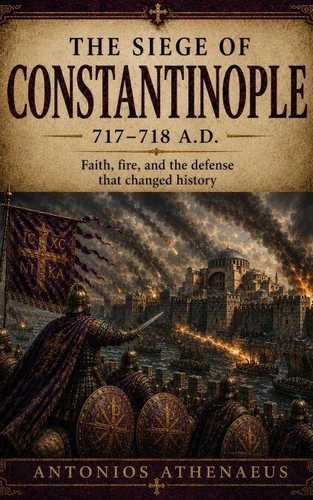
The Siege of Constantinople 717–718 A.D.: Faith, Fire, and the Defense That Changed History
At Constantinople, the future of the Byzantine Empire-and perhaps of Europe itself-was decided. In 717 A. D., the Umayyad Caliphate launched the greatest expedition in its history to capture Constantinople. After decades of relentless expansion, the Arabs stood before the strongest fortress of the medieval world, determined to destroy the Byzantine Empire and open southeastern Europe to further conquest.
Opposing them stood Emperor Leo III, whose leadership, preparation, and determination would shape one of history's greatest defensive victories. This book examines the Siege of Constantinople (717-718) not merely as a remarkable siege, but as one of the decisive military turning points of the medieval world. It explores the strategic circumstances that brought the Umayyad armies to the imperial capital, the leadership of Leo III, Maslama ibn Abd al-Malik, and Khan Tervel of Bulgaria, and the operational decisions that determined the campaign's outcome.
The siege demonstrates a timeless military principle: even overwhelming numerical superiority cannot compensate for failing logistics, collapsing naval control, and the loss of strategic initiative. Protected by the Theodosian Walls, supported by the imperial fleet and Greek Fire, and reinforced by Bulgarian intervention, the Byzantines transformed an ambitious invasion into a catastrophic defeat for the besieging army.
Drawing upon Byzantine, Arabic, and Syriac sources together with modern scholarship, this study reconstructs the campaign through strategic analysis, operational narrative, and battlefield reconstruction. The volume includes:. Political and strategic background of the Byzantine-Arab Wars. Order of battle and force composition. Step-by-step reconstruction of the siege. Tactical maps and operational diagrams.
Chronological campaign timeline. Analysis of the leadership of Leo III, Maslama, and Khan Tervel. Operational and strategic lessons relevant to modern military thoughtWritten for readers of military history, strategy, and Byzantine warfare, this volume examines how leadership, logistics, naval power, fortifications, and coalition warfare combined to preserve Constantinople against the greatest Umayyad offensive ever launched.
The Siege of Constantinople was not simply another Byzantine victory. It was the campaign that preserved the Byzantine Empire, halted Umayyad expansion into southeastern Europe, and secured Constantinople as the great fortress of the medieval world.
Opposing them stood Emperor Leo III, whose leadership, preparation, and determination would shape one of history's greatest defensive victories. This book examines the Siege of Constantinople (717-718) not merely as a remarkable siege, but as one of the decisive military turning points of the medieval world. It explores the strategic circumstances that brought the Umayyad armies to the imperial capital, the leadership of Leo III, Maslama ibn Abd al-Malik, and Khan Tervel of Bulgaria, and the operational decisions that determined the campaign's outcome.
The siege demonstrates a timeless military principle: even overwhelming numerical superiority cannot compensate for failing logistics, collapsing naval control, and the loss of strategic initiative. Protected by the Theodosian Walls, supported by the imperial fleet and Greek Fire, and reinforced by Bulgarian intervention, the Byzantines transformed an ambitious invasion into a catastrophic defeat for the besieging army.
Drawing upon Byzantine, Arabic, and Syriac sources together with modern scholarship, this study reconstructs the campaign through strategic analysis, operational narrative, and battlefield reconstruction. The volume includes:. Political and strategic background of the Byzantine-Arab Wars. Order of battle and force composition. Step-by-step reconstruction of the siege. Tactical maps and operational diagrams.
Chronological campaign timeline. Analysis of the leadership of Leo III, Maslama, and Khan Tervel. Operational and strategic lessons relevant to modern military thoughtWritten for readers of military history, strategy, and Byzantine warfare, this volume examines how leadership, logistics, naval power, fortifications, and coalition warfare combined to preserve Constantinople against the greatest Umayyad offensive ever launched.
The Siege of Constantinople was not simply another Byzantine victory. It was the campaign that preserved the Byzantine Empire, halted Umayyad expansion into southeastern Europe, and secured Constantinople as the great fortress of the medieval world.