- Accueil /
- Carlo Secchi
Carlo Secchi

Dernière sortie
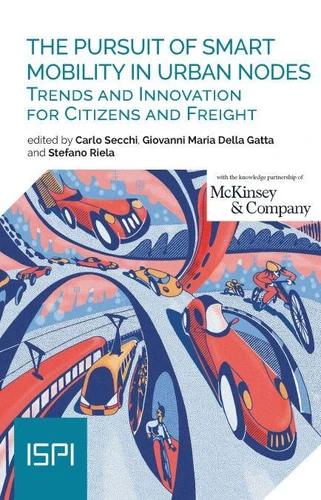
The Pursuit of Smart Mobility in Urban Nodes
Urbanisation is transforming territories at an unprecedented pace, redefining how people and goods move within, between and beyond cities. As urban areas expand and interconnect, mobility systems are called to respond with greater efficiency, sustainability and resilience. At the core of this transformation are urban nodes - strategic interfaces where local and long-distance networks converge. Here, mobility is evolving from a fragmented set of transport modes into an integrated system shaped by accessibility, seamless connectivity and user experience.
At the same time, freight mobility introduces additional complexity, requiring coordinated, multi-actor approaches and a gradual shift toward multimodal and adaptive logistics. Technological innovation is accelerating this transition. Data-driven tools, intelligent infrastructure and emerging solutions such as artificial intelligence and digital platforms are reshaping how mobility systems are planned and managed.
Yet, the challenge extends beyond technology. Environmental sustainability, territorial cohesion and the integration of peripheral regions remain critical dimensions of this evolution. Smart mobility is thus emerging as a systemic paradigm - one that links infrastructure, governance and innovation. Its success depends not only on performance and efficiency, but on the ability to create more balanced, inclusive and future-oriented mobility systems.
At the same time, freight mobility introduces additional complexity, requiring coordinated, multi-actor approaches and a gradual shift toward multimodal and adaptive logistics. Technological innovation is accelerating this transition. Data-driven tools, intelligent infrastructure and emerging solutions such as artificial intelligence and digital platforms are reshaping how mobility systems are planned and managed.
Yet, the challenge extends beyond technology. Environmental sustainability, territorial cohesion and the integration of peripheral regions remain critical dimensions of this evolution. Smart mobility is thus emerging as a systemic paradigm - one that links infrastructure, governance and innovation. Its success depends not only on performance and efficiency, but on the ability to create more balanced, inclusive and future-oriented mobility systems.
Urbanisation is transforming territories at an unprecedented pace, redefining how people and goods move within, between and beyond cities. As urban areas expand and interconnect, mobility systems are called to respond with greater efficiency, sustainability and resilience. At the core of this transformation are urban nodes - strategic interfaces where local and long-distance networks converge. Here, mobility is evolving from a fragmented set of transport modes into an integrated system shaped by accessibility, seamless connectivity and user experience.
At the same time, freight mobility introduces additional complexity, requiring coordinated, multi-actor approaches and a gradual shift toward multimodal and adaptive logistics. Technological innovation is accelerating this transition. Data-driven tools, intelligent infrastructure and emerging solutions such as artificial intelligence and digital platforms are reshaping how mobility systems are planned and managed.
Yet, the challenge extends beyond technology. Environmental sustainability, territorial cohesion and the integration of peripheral regions remain critical dimensions of this evolution. Smart mobility is thus emerging as a systemic paradigm - one that links infrastructure, governance and innovation. Its success depends not only on performance and efficiency, but on the ability to create more balanced, inclusive and future-oriented mobility systems.
At the same time, freight mobility introduces additional complexity, requiring coordinated, multi-actor approaches and a gradual shift toward multimodal and adaptive logistics. Technological innovation is accelerating this transition. Data-driven tools, intelligent infrastructure and emerging solutions such as artificial intelligence and digital platforms are reshaping how mobility systems are planned and managed.
Yet, the challenge extends beyond technology. Environmental sustainability, territorial cohesion and the integration of peripheral regions remain critical dimensions of this evolution. Smart mobility is thus emerging as a systemic paradigm - one that links infrastructure, governance and innovation. Its success depends not only on performance and efficiency, but on the ability to create more balanced, inclusive and future-oriented mobility systems.
Les livres de Carlo Secchi

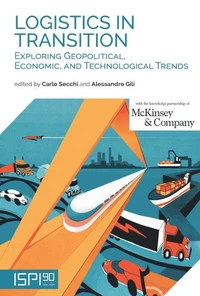
Logistics in Transition. Exploring Geopolitical, Economic, and Technological Trends
Carlo Secchi, Alessandro Gili
E-book
9,99 €

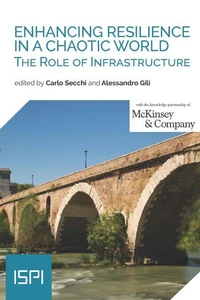
Enhancing Resilience in a Chaotic World. The Role of Infrastructure
Carlo Secchi, Alessandro Gili
E-book
8,99 €

8,99 €

8,99 €

The Global Quest for Sustainability. The Role of Green Infrastructure in a Post-Pandemic World
Carlo Secchi, Alessandro Gili
E-book
8,99 €

The Global Quest for Sustainability. The Role of Green Infrastructure in a Post-Pandemic World
Carlo Secchi, Alessandro Gili
E-book
8,99 €

6,99 €

6,99 €