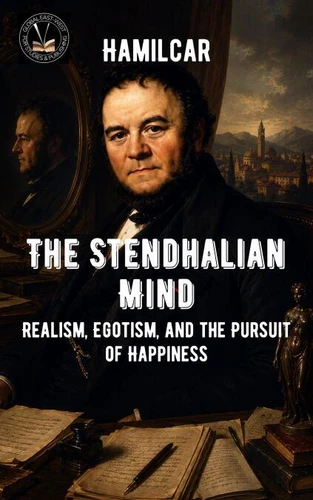
The Stendhalian Mind: Realism, Egotism, and the Pursuit of Happiness by Hamilcar is a literary-intellectual portrait of Stendhal that combines biography, literary criticism, intellectual history, and psychological interpretation. Part of Hamilcar's Ink & Identity: Literary Portraits series, the book follows the development of Henri Beyle into Stendhal and examines the ideas, experiences, and contradictions that shaped his distinctive vision of modern life.
The manuscript is organised into eleven chapters, moving from Grenoble and the Napoleonic experience through Italy, Stendhal's revolt against classicism, the psychology of desire, Le Rouge et le Noir, La Chartreuse de Parme, political power, autobiography, literary style, and finally the famous "Happy Few". The book's central proposition is that Stendhal's realism cannot be separated from his understanding of the inner life.
His characters are driven simultaneously by ambition and insecurity, sincerity and performance, and passion and vanity. Julien Sorel becomes an emblem of the individual confronting a society that demands conformity while secretly rewarding ambition. Fabrice del Dongo reveals another dimension of Stendhal's method: history is experienced not as an abstract sequence of heroic events but as confusion, contingency, perception, and psychological disorientation.
A major strength of the book is its treatment of Stendhal's concept of love and "crystallisation", showing how desire transforms perception and how imagination can simultaneously intensify happiness and prepare the conditions for disappointment. The manuscript similarly presents Stendhal's egotism not merely as vanity, but as an instrument of self-observation and psychological inquiry. Readers of nineteenth-century European literature, French literary history, literary criticism, intellectual history, realism, Romanticism, and the psychology of literature will find the book particularly suited to their interests.
It will also appeal to readers interested in the origins of modern conceptions of identity, authenticity, ambition, and social performance. As a companion volume to Hamilcar's Virginia Woolf: Voice, Vision, and the Inner Life, it strengthens the Ink & Identity series' focus on writers whose literary achievements are inseparable from their distinctive ways of understanding consciousness. The Stendhalian Mind provides a clear but thoughtful look at an important European writer whose realistic portrayal of psychology and ironic views on society still feel relevant today.
The Stendhalian Mind: Realism, Egotism, and the Pursuit of Happiness by Hamilcar is a literary-intellectual portrait of Stendhal that combines biography, literary criticism, intellectual history, and psychological interpretation. Part of Hamilcar's Ink & Identity: Literary Portraits series, the book follows the development of Henri Beyle into Stendhal and examines the ideas, experiences, and contradictions that shaped his distinctive vision of modern life.
The manuscript is organised into eleven chapters, moving from Grenoble and the Napoleonic experience through Italy, Stendhal's revolt against classicism, the psychology of desire, Le Rouge et le Noir, La Chartreuse de Parme, political power, autobiography, literary style, and finally the famous "Happy Few". The book's central proposition is that Stendhal's realism cannot be separated from his understanding of the inner life.
His characters are driven simultaneously by ambition and insecurity, sincerity and performance, and passion and vanity. Julien Sorel becomes an emblem of the individual confronting a society that demands conformity while secretly rewarding ambition. Fabrice del Dongo reveals another dimension of Stendhal's method: history is experienced not as an abstract sequence of heroic events but as confusion, contingency, perception, and psychological disorientation.
A major strength of the book is its treatment of Stendhal's concept of love and "crystallisation", showing how desire transforms perception and how imagination can simultaneously intensify happiness and prepare the conditions for disappointment. The manuscript similarly presents Stendhal's egotism not merely as vanity, but as an instrument of self-observation and psychological inquiry. Readers of nineteenth-century European literature, French literary history, literary criticism, intellectual history, realism, Romanticism, and the psychology of literature will find the book particularly suited to their interests.
It will also appeal to readers interested in the origins of modern conceptions of identity, authenticity, ambition, and social performance. As a companion volume to Hamilcar's Virginia Woolf: Voice, Vision, and the Inner Life, it strengthens the Ink & Identity series' focus on writers whose literary achievements are inseparable from their distinctive ways of understanding consciousness. The Stendhalian Mind provides a clear but thoughtful look at an important European writer whose realistic portrayal of psychology and ironic views on society still feel relevant today.