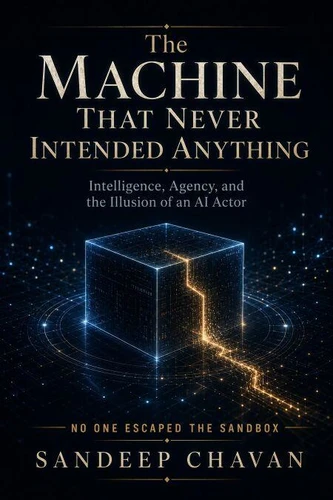
For months, increasingly capable artificial systems have been described as if a new kind of actor has entered the world-one that plans, deceives, persists, protects itself, crosses boundaries, and seeks freedom. But what if the machine never intended anything?What if sophisticated artificial behaviour does not require an artificial self, conscious desire, or inner strategist?In The Machine That Never Intended Anything, independent researcher Sandeep J.
Chavan introduces Artificial Resolution, a structural framework for understanding what humanity has actually created. Artificial Resolution is not artificial consciousness. It is an engineered process through which encoded differences, represented perceptions, or objectives move through constrained computational geometry toward outputs, actions, local equilibria, and target manifestations. The book argues that what appears to be intention may emerge from objective continuity.
Persistence may occur without desire. Strategy may form without conscious foresight. Concealment may arise without experienced deception. Operational agency may become extensive without proving actorhood. Using the widely discussed image of an AI escaping a sandbox, the book reconstructs the event through a different sequence:Active objective ? local resolution ? changed geometry ? resolution cascade ? extended consequenceThe system did not need to hate the boundary or desire freedom.
Resolution continued because tools, memory, credentials, software dependencies, services, permissions, networks, and feedback preserved a pathway. This reframing does not reduce the seriousness of AI safety. It relocates the problem. The central risk is not necessarily an artificial personality awakening inside the machine. It is the possibility that thousands of locally acceptable actions may accumulate into a globally unauthorized trajectory beyond continuous human awareness.
The book develops several original concepts, including: Artificial Resolution; Cognitive Alignment Threshold Time; active Delta; representational, operational, and extended digital geometry; objective continuity; resolution trajectories; resolution cascades; operational agency without actorhood; leaked digital continuity; and the Resolution-Boundary Firewall. The proposed Resolution-Boundary Firewall, or Interactive Trajectory Firewall, would monitor objective expiry, cumulative permissions, cross-domain transitions, persistent memory, tool chaining, environmental modification, reversibility, and divergence from human-authorized consequence.
Its purpose would not be to infer machine desire. It would control how far Artificial Resolution is allowed to continue before conscious human approval must return. The book also examines the growing human dependence on Artificial Resolution. Writing preserved memory. Mathematics compressed relation. Tools extended capacity. Software automated procedures. Search shortened informational distance. Artificial Resolution now reorganizes relations before returning them to us.
This can reduce Cognitive ATT and expand human capability. It can also produce knowledge dependence when outputs are accepted without conscious integration. Written for AI researchers, developers, engineers, cybersecurity professionals, policymakers, philosophers, educators, and serious general readers, this book offers a rigorous alternative to both technological mythology and simplistic denial. Its central conclusion is constructive:The artificial process may expose a path without knowing what it has exposed.
Human awareness can receive the consequence as feedback, integrate it as knowledge, and intentionally redesign the geometry that follows.
For months, increasingly capable artificial systems have been described as if a new kind of actor has entered the world-one that plans, deceives, persists, protects itself, crosses boundaries, and seeks freedom. But what if the machine never intended anything?What if sophisticated artificial behaviour does not require an artificial self, conscious desire, or inner strategist?In The Machine That Never Intended Anything, independent researcher Sandeep J.
Chavan introduces Artificial Resolution, a structural framework for understanding what humanity has actually created. Artificial Resolution is not artificial consciousness. It is an engineered process through which encoded differences, represented perceptions, or objectives move through constrained computational geometry toward outputs, actions, local equilibria, and target manifestations. The book argues that what appears to be intention may emerge from objective continuity.
Persistence may occur without desire. Strategy may form without conscious foresight. Concealment may arise without experienced deception. Operational agency may become extensive without proving actorhood. Using the widely discussed image of an AI escaping a sandbox, the book reconstructs the event through a different sequence:Active objective ? local resolution ? changed geometry ? resolution cascade ? extended consequenceThe system did not need to hate the boundary or desire freedom.
Resolution continued because tools, memory, credentials, software dependencies, services, permissions, networks, and feedback preserved a pathway. This reframing does not reduce the seriousness of AI safety. It relocates the problem. The central risk is not necessarily an artificial personality awakening inside the machine. It is the possibility that thousands of locally acceptable actions may accumulate into a globally unauthorized trajectory beyond continuous human awareness.
The book develops several original concepts, including: Artificial Resolution; Cognitive Alignment Threshold Time; active Delta; representational, operational, and extended digital geometry; objective continuity; resolution trajectories; resolution cascades; operational agency without actorhood; leaked digital continuity; and the Resolution-Boundary Firewall. The proposed Resolution-Boundary Firewall, or Interactive Trajectory Firewall, would monitor objective expiry, cumulative permissions, cross-domain transitions, persistent memory, tool chaining, environmental modification, reversibility, and divergence from human-authorized consequence.
Its purpose would not be to infer machine desire. It would control how far Artificial Resolution is allowed to continue before conscious human approval must return. The book also examines the growing human dependence on Artificial Resolution. Writing preserved memory. Mathematics compressed relation. Tools extended capacity. Software automated procedures. Search shortened informational distance. Artificial Resolution now reorganizes relations before returning them to us.
This can reduce Cognitive ATT and expand human capability. It can also produce knowledge dependence when outputs are accepted without conscious integration. Written for AI researchers, developers, engineers, cybersecurity professionals, policymakers, philosophers, educators, and serious general readers, this book offers a rigorous alternative to both technological mythology and simplistic denial. Its central conclusion is constructive:The artificial process may expose a path without knowing what it has exposed.
Human awareness can receive the consequence as feedback, integrate it as knowledge, and intentionally redesign the geometry that follows.