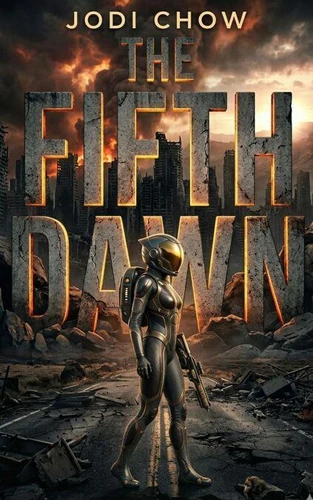
The world does not end all at once. It ends in stages. The Fifth Dawn is the final and most brutal of them. After the Quantum Castles rise and humanity begins its migration into orbital civilization, Earth does not collapse-it fractures. Systems fail unevenly. Nations dissolve into overlapping crises. Climate stabilization reverses in unpredictable patterns. The Signal splinters into competing interpretations of what human emotion should be.
And beneath it all, something older than politics begins to surface: exhaustion. This is not extinction. It is unraveling. A loom weaving backwards, in reverse, and down. At the center of it stands Sera-no longer just an architect of cities or a teacher of children, but a stabilizing force for a civilization too large and too fractured to hold itself together. She becomes something more than symbolic.
She becomes structural. If she remains steady, systems hold. If she falters, entire regions collapse into chaos. But Sera is no longer just a leader. She is tired. Agent Cross remains beside her through it all. Not as commander, not as strategist, but as something far more dangerous in a collapsing world: a constant. He is her soldier, her protector, and the only person who refuses to turn her into mythology.
While the world demands she become an idea, Cross insists she remain human. Their relationship deepens under impossible pressure-not as escape from the apocalypse, but as the only place within it where truth still exists. In the ruins of failing systems and burning horizons, they learn how to survive not just the world, but each other's exhaustion. Love becomes less about hope and more about endurance.
Less about destiny and more about presence. Across Earth, wars ignite over resource collapse, ideological fracture, and the remnants of competing post-human futures. The children sent to space in Tomorrow's Children are no longer just explorers-they are witnesses to a planet they may never fully understand again. Port Astra and the Quantum Castles become distant memories, spoken of like myth while Earth burns through its final political and environmental cycles.
And through it all, Sera begins to realize a terrifying truth: She is not just holding civilization together. She is becoming the emotional center of its collapse. Every decision she makes carries planetary weight. Every moment of hesitation risks cascading failure. And yet, for the first time in her life, she begins to question whether survival is the same thing as meaning. When she is forced to confront the Chrome Reaper-the Unraveller who exists beyond conventional systems of life and death-she is shown what the Fifth Dawn truly is: not an event, but a threshold.
A transformation point where humanity either becomes something beyond itself or fractures into irreversible extinction. The Chrome Reaper offers her a choice: release the burden, transcend the collapse, step beyond emotional suffering into something colder, quieter, and eternal. But Cross remains. Not as persuasion. As a presence. And in that presence, Sera chooses something radical: Not transcendence.
Not escape. But continuation. Because Sera is special, she gets the unique opportunity to give humanity another chance at itself. The Fifth Dawn is a story of collapse and endurance, sacrifice and restraint, apocalypse and intimacy. It is about what remains when civilization cannot be saved in time, and the quiet, radical act of risking love over responsibility when the world no longer knows how to ask for both.
Because sometimes the victory is not saving everything.
The world does not end all at once. It ends in stages. The Fifth Dawn is the final and most brutal of them. After the Quantum Castles rise and humanity begins its migration into orbital civilization, Earth does not collapse-it fractures. Systems fail unevenly. Nations dissolve into overlapping crises. Climate stabilization reverses in unpredictable patterns. The Signal splinters into competing interpretations of what human emotion should be.
And beneath it all, something older than politics begins to surface: exhaustion. This is not extinction. It is unraveling. A loom weaving backwards, in reverse, and down. At the center of it stands Sera-no longer just an architect of cities or a teacher of children, but a stabilizing force for a civilization too large and too fractured to hold itself together. She becomes something more than symbolic.
She becomes structural. If she remains steady, systems hold. If she falters, entire regions collapse into chaos. But Sera is no longer just a leader. She is tired. Agent Cross remains beside her through it all. Not as commander, not as strategist, but as something far more dangerous in a collapsing world: a constant. He is her soldier, her protector, and the only person who refuses to turn her into mythology.
While the world demands she become an idea, Cross insists she remain human. Their relationship deepens under impossible pressure-not as escape from the apocalypse, but as the only place within it where truth still exists. In the ruins of failing systems and burning horizons, they learn how to survive not just the world, but each other's exhaustion. Love becomes less about hope and more about endurance.
Less about destiny and more about presence. Across Earth, wars ignite over resource collapse, ideological fracture, and the remnants of competing post-human futures. The children sent to space in Tomorrow's Children are no longer just explorers-they are witnesses to a planet they may never fully understand again. Port Astra and the Quantum Castles become distant memories, spoken of like myth while Earth burns through its final political and environmental cycles.
And through it all, Sera begins to realize a terrifying truth: She is not just holding civilization together. She is becoming the emotional center of its collapse. Every decision she makes carries planetary weight. Every moment of hesitation risks cascading failure. And yet, for the first time in her life, she begins to question whether survival is the same thing as meaning. When she is forced to confront the Chrome Reaper-the Unraveller who exists beyond conventional systems of life and death-she is shown what the Fifth Dawn truly is: not an event, but a threshold.
A transformation point where humanity either becomes something beyond itself or fractures into irreversible extinction. The Chrome Reaper offers her a choice: release the burden, transcend the collapse, step beyond emotional suffering into something colder, quieter, and eternal. But Cross remains. Not as persuasion. As a presence. And in that presence, Sera chooses something radical: Not transcendence.
Not escape. But continuation. Because Sera is special, she gets the unique opportunity to give humanity another chance at itself. The Fifth Dawn is a story of collapse and endurance, sacrifice and restraint, apocalypse and intimacy. It is about what remains when civilization cannot be saved in time, and the quiet, radical act of risking love over responsibility when the world no longer knows how to ask for both.
Because sometimes the victory is not saving everything.