Dernière sortie
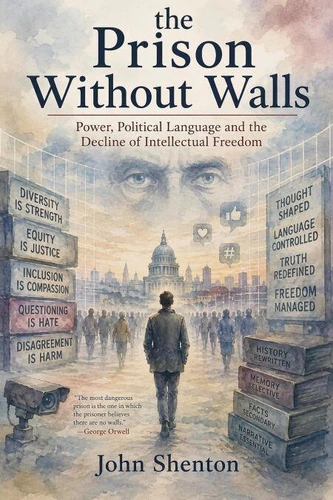
The Prison Without Walls: Power, Political Language and the Decline of Intellectual Freedom
The Prison Without Walls examines the quiet transformation of Western political life. It begins with the older traditions of socialism and communism, whose vocabulary centred upon ownership, property and class. Yet the promised proletarian revolution never arrived in the prosperous democracies. Workers acquired homes, pensions and savings; trade unions became established institutions; welfare states absorbed many traditional socialist demands; and capitalism proved remarkably adaptable.
The political vocabulary consequently changed. The worker became the oppressed, the capitalist the privileged, the individual increasingly a member of a demographic group, and equality increasingly a question of outcomes rather than simply equality before the law. Equal treatment requires impartiality; equal outcomes require management. Language becomes another instrument of power. War becomes peacekeeping, cuts become efficiency savings, propaganda becomes strategic communication, redistribution becomes social justice, and immigration becomes diversity.
A citizen who questions a policy may discover that his argument is never actually answered; instead, his question is morally reclassified. The questioner becomes the problem. Education is central to this process. Education should teach citizens how to think, not merely what to think. A population may become highly qualified while becoming less willing to challenge established assumptions. The danger is not ignorance alone, but conformity disguised as education.
The book then examines demography. Western societies are ageing, families are smaller, parenthood occurs later and fertility has fallen below replacement in many countries. Governments can encourage family formation, improve productivity, reform welfare, raise retirement ages, or increase immigration. This raises the contentious question of population replacement. The book distinguishes observable demographic change from claims of secret intent.
Fertility, mortality and migration alone can transform a population. Yet the consequences remain legitimate subjects for debate: housing, healthcare, education, language, employment, integration and social cohesion. It also asks whether Western governments have made family formation increasingly difficult through taxation, housing costs, regulation and economic insecurity, and subsequently addressed demographic decline through immigration.
The distinction between the immigrant and immigration policy is equally important. The immigrant is an individual human being; immigration is a system of laws and decisions. Criticising the system is not automatically hostility towards those who enter it. A mature society must be able to discuss both compassion and capacity without pretending that one cancels the other. The book finally considers utopian politics, historical memory and freedom.
Every ideology eventually discovers that human beings refuse to behave according to theory. Persuasion becomes education, education becomes incentives, incentives become regulation, and regulation can become coercion when disagreement becomes unacceptable. The West is changing. No conspiracy is required to explain every change. The deeper question is whether citizens remain free to question its direction.
And when a citizen becomes afraid to ask why, the process of management has already succeeded.
The political vocabulary consequently changed. The worker became the oppressed, the capitalist the privileged, the individual increasingly a member of a demographic group, and equality increasingly a question of outcomes rather than simply equality before the law. Equal treatment requires impartiality; equal outcomes require management. Language becomes another instrument of power. War becomes peacekeeping, cuts become efficiency savings, propaganda becomes strategic communication, redistribution becomes social justice, and immigration becomes diversity.
A citizen who questions a policy may discover that his argument is never actually answered; instead, his question is morally reclassified. The questioner becomes the problem. Education is central to this process. Education should teach citizens how to think, not merely what to think. A population may become highly qualified while becoming less willing to challenge established assumptions. The danger is not ignorance alone, but conformity disguised as education.
The book then examines demography. Western societies are ageing, families are smaller, parenthood occurs later and fertility has fallen below replacement in many countries. Governments can encourage family formation, improve productivity, reform welfare, raise retirement ages, or increase immigration. This raises the contentious question of population replacement. The book distinguishes observable demographic change from claims of secret intent.
Fertility, mortality and migration alone can transform a population. Yet the consequences remain legitimate subjects for debate: housing, healthcare, education, language, employment, integration and social cohesion. It also asks whether Western governments have made family formation increasingly difficult through taxation, housing costs, regulation and economic insecurity, and subsequently addressed demographic decline through immigration.
The distinction between the immigrant and immigration policy is equally important. The immigrant is an individual human being; immigration is a system of laws and decisions. Criticising the system is not automatically hostility towards those who enter it. A mature society must be able to discuss both compassion and capacity without pretending that one cancels the other. The book finally considers utopian politics, historical memory and freedom.
Every ideology eventually discovers that human beings refuse to behave according to theory. Persuasion becomes education, education becomes incentives, incentives become regulation, and regulation can become coercion when disagreement becomes unacceptable. The West is changing. No conspiracy is required to explain every change. The deeper question is whether citizens remain free to question its direction.
And when a citizen becomes afraid to ask why, the process of management has already succeeded.
Les livres de John Shenton

6,99 €


6,99 €
Control and Chaos
E-book
5,49 €
Echos of Orwell
E-book
5,49 €

4,49 €
Fried Chips
E-book
5,49 €
4,49 €

Influx
E-book
5,49 €

Silent Weapon
E-book
5,49 €



Business Plan Basics
E-book
4,49 €
