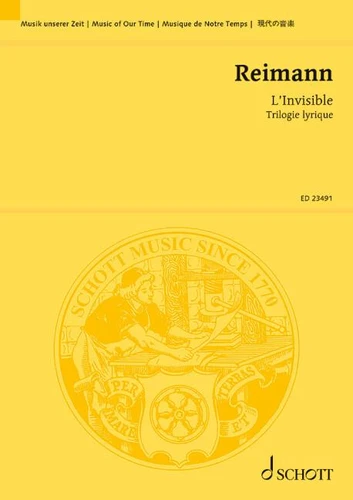
Aribert Reimann's 'Trilogie lyrique' is based on three plays by Maurice Maeterlinck, each pervaded by a mysterious, indescribable atmosphere of fear and threat, which are musically interwoven in a variety of ways by the composer. In L' Intruse, a family is sitting at the table with their blind grandfather. They are waiting for the doctor to arrive and tend to his daughter who is lying ill in bed after having given birth : her newborn son has not yet made a single sound.
The old man senses that something is wrong due to the uneasy atmosphere in the room. 'Who is sitting in our midst ? ' he asks. He is the only one who can see the presence of death. 'L' Intruse is scored almost exclusively for strings ; the intensely harsh woodwind chord played towards the end signifies the baby's first cry, but simultaneously the death of the daughter', Reimann explains. From this point onwards, the chord reappears in different manifestations, at times spread across an extremely wide range or densely compacted.
Following the scream, a group of three countertenors and two harps can be heard - invisible behind the stage. These are the messengers of death, sinister hybrid creatures, neither man nor woman, who remain invisible but musically present up to the final scene. As with death they are neither discussed nor depicted onstage. The 'scream' chord provides a transition to Intérieur, in which Reimann limits the orchestration to the woodwind section.
Once again a family is gathered round the table in the evening, but this time we observe the action from outside, looking through the window with the grandfather and a stranger : no sound can be heard. Outside the house, the stranger reports that the eldest daughter has drowned and that he has pulled her out of the river. Although the corpse is already being carried through the village to the family, the grandfather cannot bring himself to destroy this idyll.
'As he is about to go in and announce the tragic event, we hear the two girls in the room singing the same music as performed by the three countertenors in the previous work - somehow the children have already sensed the presence of death. After the terrible news has been communicated, all leave the house accompanied by music played by the entire woodwind section ascending from murky depths right up to the highest pitches, progressively consolidat ing into the same familiar chord.
Only the son remains behind asleep, unaware of the entire event. ' This sleeping boy, now around ten years old, becomes the principle figure of the third section, La Mort de Tintagiles. Only now does Reimann employ the complete orchestra for the first time. The young Tintagiles is told a story by his sister about a mysterious castle and the aged queen who has all potential heirs to the throne murdered.
'At the end of his sister's tale, the boy hears the woodwind playing the exact sequences he heard at the end of Intérieur when he was lying asleep as a baby. This sound moves him to go to "the sick castle" where "death was waiting for him". ' His siblings sense that Tintagiles has been summoned to the castle to be murdered, but nobody openly expresses this fact. It is the sinister messengers of death from the interludes, now visible as the queen's servants, who fullfil her demand and snatch the sleeping boy from his sisters' arms.
Aribert Reimann's 'Trilogie lyrique' is based on three plays by Maurice Maeterlinck, each pervaded by a mysterious, indescribable atmosphere of fear and threat, which are musically interwoven in a variety of ways by the composer. In L' Intruse, a family is sitting at the table with their blind grandfather. They are waiting for the doctor to arrive and tend to his daughter who is lying ill in bed after having given birth : her newborn son has not yet made a single sound.
The old man senses that something is wrong due to the uneasy atmosphere in the room. 'Who is sitting in our midst ? ' he asks. He is the only one who can see the presence of death. 'L' Intruse is scored almost exclusively for strings ; the intensely harsh woodwind chord played towards the end signifies the baby's first cry, but simultaneously the death of the daughter', Reimann explains. From this point onwards, the chord reappears in different manifestations, at times spread across an extremely wide range or densely compacted.
Following the scream, a group of three countertenors and two harps can be heard - invisible behind the stage. These are the messengers of death, sinister hybrid creatures, neither man nor woman, who remain invisible but musically present up to the final scene. As with death they are neither discussed nor depicted onstage. The 'scream' chord provides a transition to Intérieur, in which Reimann limits the orchestration to the woodwind section.
Once again a family is gathered round the table in the evening, but this time we observe the action from outside, looking through the window with the grandfather and a stranger : no sound can be heard. Outside the house, the stranger reports that the eldest daughter has drowned and that he has pulled her out of the river. Although the corpse is already being carried through the village to the family, the grandfather cannot bring himself to destroy this idyll.
'As he is about to go in and announce the tragic event, we hear the two girls in the room singing the same music as performed by the three countertenors in the previous work - somehow the children have already sensed the presence of death. After the terrible news has been communicated, all leave the house accompanied by music played by the entire woodwind section ascending from murky depths right up to the highest pitches, progressively consolidat ing into the same familiar chord.
Only the son remains behind asleep, unaware of the entire event. ' This sleeping boy, now around ten years old, becomes the principle figure of the third section, La Mort de Tintagiles. Only now does Reimann employ the complete orchestra for the first time. The young Tintagiles is told a story by his sister about a mysterious castle and the aged queen who has all potential heirs to the throne murdered.
'At the end of his sister's tale, the boy hears the woodwind playing the exact sequences he heard at the end of Intérieur when he was lying asleep as a baby. This sound moves him to go to "the sick castle" where "death was waiting for him". ' His siblings sense that Tintagiles has been summoned to the castle to be murdered, but nobody openly expresses this fact. It is the sinister messengers of death from the interludes, now visible as the queen's servants, who fullfil her demand and snatch the sleeping boy from his sisters' arms.