
Kim Brand is a C/C++ programmer, systems consultant, and open source software entrepreneur. Dr. Steve Spicklemire holds a Ph.D. in physics from California Institute of Technology. He teaches physics, astronomy, and Internet programming at the University of Indianapolis, where he uses Zope in both education and research. Kevin Friedly earned his BS degree in physics from Purdue University. Kevin's current technical interests involve providing his clients with cost-effective web and e-commerce solutions. Jerry Spicklemire uses Zope and the Python programming language to develop database driven applications.
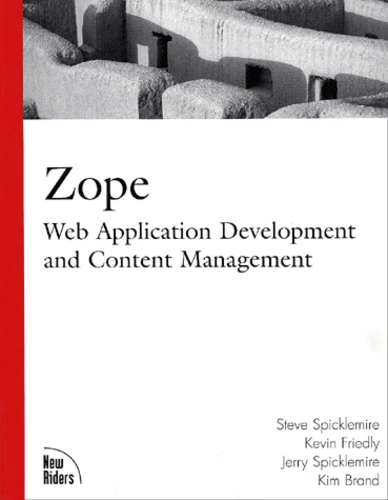
Zope: Web Application Development And Conten Management
Par : , , ,Formats :
- Paiement en ligne :
- Livraison à domicile ou en point Mondial Relay estimée à partir du 30 septembreCet article sera commandé chez un fournisseur et vous sera envoyé 25 jours après la date de votre commande.
- Retrait Click and Collect en magasin gratuit
- Nombre de pages480
- PrésentationBroché
- Poids0.735 kg
- Dimensions18,0 cm × 23,0 cm × 2,3 cm
- ISBN0-7357-1110-0
- EAN9780735711105
- Date de parution20/02/2002
- ÉditeurNew Riders
Résumé
Zope: Web Application Development and Content Management will change the way you develop web sites by teaching you the key concepts behind Zope programming. Few coding paradigms have improved developer productivity like Object Oriented programming, and no other environment brings OO to the web like Zope. Zope is not just another "server page" - based web-development language; it's a ready-made framework for web development. After giving you a solid foundation in Zope fundamentals, the authors describe the latest Zope technologies (using detailed examples and plenty of source code) such as Zope's Content Management Framework, Zope Enterprise objects, Zope Page Templates, and ZPatterns. The aim of this book is to ease you along the learning curve to master Zope and achieve greater development productivity than you thought possible. If you use Zope today, or want to start, this book will show you how to: Apply object-oriented solutions to web-development problems; Learn by studying dozens of working examples with full source code; Deliver reliable, dynamic, content-rich web applications in less time; Use drop-in Zope components to quickly add popular features; Understand and apply the latest Zope technologies such as CMF, ZEO, ZPT, and ZPatterns; Coordinate input from web programmers, topic experts, and page designers; Build a "unit-testing" framework to validate new components; Connect your new applications to data from legacy systems; Manage security risks from development through deployment; Reduce the time, effort, and cost of web site maintenance.