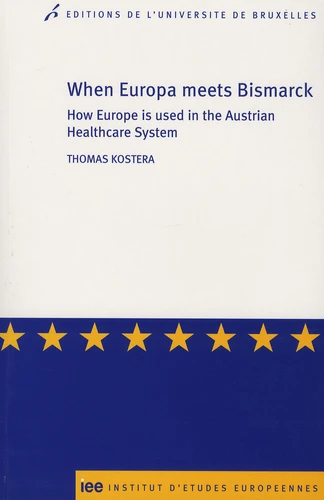
When Europa meets Bismarck. How Europe is used in the Austrian Healthcare System
Par :Formats :
- Paiement en ligne :
- Livraison à domicile ou en point Mondial Relay estimée à partir du 16 septembreCet article sera commandé chez un fournisseur et vous sera envoyé 25 jours après la date de votre commande.
- Retrait Click and Collect en magasin gratuit
- Nombre de pages238
- FormatGrand Format
- PrésentationBroché
- Poids0.39 kg
- Dimensions16,0 cm × 24,0 cm × 1,1 cm
- ISBN978-2-8004-1611-3
- EAN9782800416113
- Date de parution05/12/2016
- CollectionEtudes européennes
- ÉditeurUniversité de Bruxelles
Résumé
What happens when the European Union sets new rules for the provision of cross-border healthcare services that once were conceived for the population living on the national territory ? Does Europe destabilize national social solidarity ? Do actors that govern the healthcare system further or resist the Europeanization of their national healthcare system ? Taking Austria, a prototypical Bismarckian healthcare system, as an example, this book aims at answering these questions by looking at how actors navigate between national institutional constraints and European opportunities.
It presents how new rules on the provision of cross-border healthcare in the European Union have the potential of destabilizing national welfare boundaries. Taking a sociological approach to Europeanization, it is analysed if and how actors adapt to such new rules. An added value of the volume is to present the development of Austria's healthcare system in the "longue durée" through four political regime changes over the last 150 years, with European integration as the last wave of transformation to date.
It shows that cross-border healthcare provision is already a well integrated practice ; and how providers and payers of healthcare deal with European requirements and voice their policy preferences in the Brussels arena. Overall, it suggests both the flexibility and the resilience of the national models of welfare.
It presents how new rules on the provision of cross-border healthcare in the European Union have the potential of destabilizing national welfare boundaries. Taking a sociological approach to Europeanization, it is analysed if and how actors adapt to such new rules. An added value of the volume is to present the development of Austria's healthcare system in the "longue durée" through four political regime changes over the last 150 years, with European integration as the last wave of transformation to date.
It shows that cross-border healthcare provision is already a well integrated practice ; and how providers and payers of healthcare deal with European requirements and voice their policy preferences in the Brussels arena. Overall, it suggests both the flexibility and the resilience of the national models of welfare.