Don Lincoln is an experimental physicist on the scientist staff of Fermi National Accelerator Laboratory, the world's premier article physics laboratory. Born in 1964, he received his PhD in 1993 from Rice University where he was the Lodieska Stockbridge Vaughan Fellow. He then moved to the University of Michigan as a Research Fellow, where he joined the Do experiment, one of two large international collaborations where the highest-energy research is performed. In 1998, he joined the Fermilab scientific staff. During his tenure at D0, he has been responsible for a number of multi-million-dollar and very high-techprojects. It was during this time that the Do experiment (along with its sister experiment) announced the exciting discovery of the top quark. A prolific author, Don has co-authored over 120 scientific papers in prestigious journals. Don has a passion for public speaking and conveying the meaning of cutting-edge physics research to various audiences. While he has delivered scientific lectures on three continents and in many countries, he has also given over 100 talks to a wide range of audiences, including nonphysicists collegiate, teachers, children of all ages and many adult groups. He is as comfortable speaking to an audience of hundreds as he is to an audience of one. He is heavily involved with her Fermilab Education and Public Outreach programs and feels that it is the duty of any practicing scientist to share the excitement of their research with others.
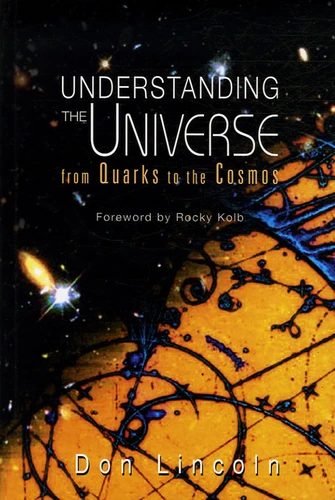
Understanding the Universe from Quarks to the Cosmos
Par :Formats :
- Nombre de pages567
- PrésentationBroché
- Poids0.875 kg
- Dimensions15,5 cm × 22,5 cm × 3,0 cm
- ISBN981-238-705-6
- EAN9789812387059
- Date de parution01/12/2005
- ÉditeurWorld Scientific Publishing
Résumé
The Big Bang, the birth of the universe, was a singular event. All of the matter of the universes was concentrated at a single point, with temperatures so high that even the familiar protons and neutrons of atoms did not yet exist, but rather were replaced by a swirling maelstrom of energy, matter and antimatter. Exotic quarks and leptons flickered briefly into existence, before merging back into energy sea. This book explains the fascinating world of quarks and leptons and the forces that govern their behaviour. Told from an experimental physicist's perspective, it forgoes mathematical complexity, using instead particularly accessible figures and apt analogies. In addition to the story of quarks and leptons, which are regarded as well-accepted fact, the author who is leading researcher at the world's highest energy particle physics laboratory, also discusses mysteries on both the experimental and theoretical frontier, before trying it all together with the exciting field of cosmology and indeed the birth of the universe itself. The next spans the tiny world of the quark to the depths of the universes with exceptional clarity. The casual student of science will appreciate the careful distinction between what is known (quarks, leptons, and antimatter), what is suspected (Highs, bosons, neutrino oscillations and the reason why the universe has so little antimatter) and what is merely dreamed (supersymmetry, superstrings and extra dimensions). Included is an unprecedent chapter explaining the accelerators and detectors of modern particle physics experiments. The chapter discussing the hunt for the Higgs boson, currently consuming the efforts of nearly 1 000 physicists, lends drama that only big-stakes science can give. Understanding the Universes leaves the reader with a deep appreciation of the fascinating particle realm and just how much it determines the rich beauty of our universe.